
Most people don’t fail because they picked a bad goal. They fail because they picked a goal framework that doesn’t match how their life actually runs. SMART goals, OKRs, and the 12 Week Year solve different problems: goal clarity, outcome alignment, and execution cadence. Here’s an honest comparison based on hands-on use of the frameworks and publicly available research, without pretending there is a definitive head-to-head study.
What’s the fastest way to choose between SMART goals, OKRs, and the 12 Week Year?
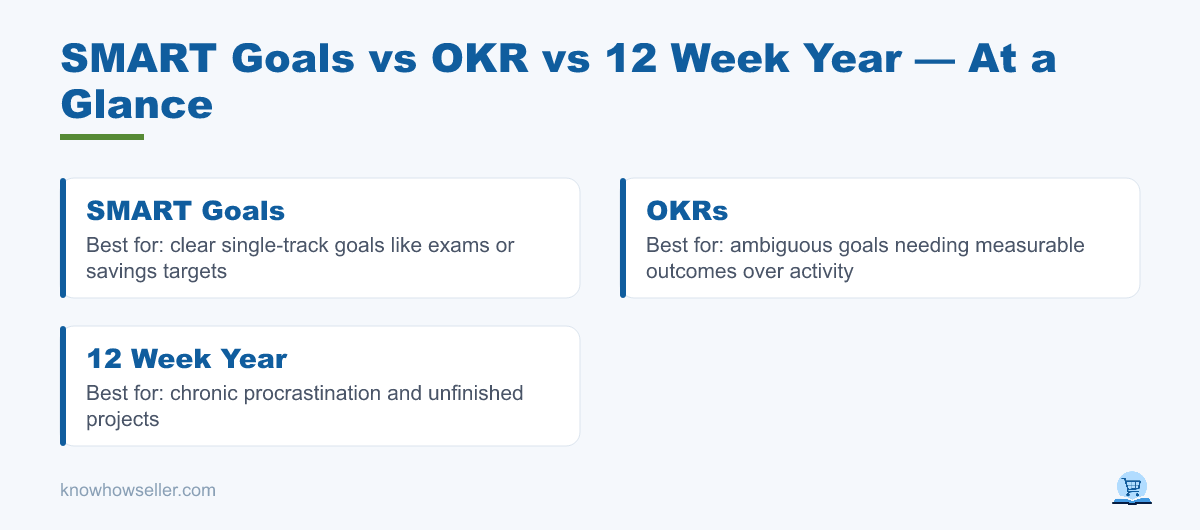
Pick SMART when the goal is already clear and you mainly need discipline. Pick OKRs when you know the direction but not the tactics, and you want measurable outcomes instead of activity. Pick the 12 Week Year when you keep starting and quitting, because its short deadline reduces the “I still have time” excuse. All three can work. The mismatch is what kills you.
How do SMART goals, OKRs, and the 12 Week Year actually differ?
SMART is a quality checklist for a single goal. OKRs are a two-layer system: a qualitative objective plus measurable key results. The 12 Week Year is a scheduling and execution system that compresses planning into 12-week cycles with weekly tactic scoring. Checklist, scoreboard, calendar — different jobs entirely.
| Dimension | SMART Goals | OKRs | 12 Week Year |
|---|---|---|---|
| Origin | George T. Doran, Management Review, 1981 | Associated with Andy Grove at Intel; popularized by John Doerr in Measure What Matters (2018) | Brian Moran & Michael Lennington, The 12 Week Year (2013) |
| Core unit | One well-formed goal statement | Objective + measurable Key Results | 12-week plan + weekly tactic scorecard |
| Time horizon | Any, depending on the goal | Often quarterly or annual in organizations | Fixed 12 weeks |
| What it measures | Whether the goal is clearly written | Outcomes: did the intended result move? | Execution: did you complete the planned tactics? |
| Best for | Clear, single-track goals: exams, savings targets, race times | Ambiguous goals with many possible tactics: income, career, growth | Chronic procrastination and unfinished projects |
| Typical failure mode | Set once, never reviewed | Over-engineered; turns into a spreadsheet hobby | Burnout if you plan too many goals at once |
| Weekly overhead | Low | Medium to high | Medium, because weekly review is central |
What happened when I ran the same three goals through all three frameworks?
A fair comparison is not about declaring one universal winner. If you apply the three frameworks to common personal goals — fitness, income, and skill-building — the trade-offs show up quickly. SMART is the fastest to write, but it needs an added review ritual. OKRs produce sharper thinking about what progress means, but they can become admin-heavy for solo users. The 12 Week Year is strongest when the real problem is drift, because it forces weekly execution review.
The scorecard (research-informed comparison, not a study)
| Metric | SMART | OKRs | 12 Week Year |
|---|---|---|---|
| Setup effort | Lowest: usually one clear goal statement | Highest: requires defining outcomes and Key Results carefully | Medium: requires a 12-week plan and weekly tactics |
| Weekly review burden | Low if you add a simple review | Medium to high if you track multiple Key Results | Medium because weekly scoring is part of the method |
| Risk of abandonment | Higher if the goal is written once and forgotten | Lower when Key Results are reviewed consistently; higher if the system feels too corporate | Lower for procrastination-prone goals because the deadline is near |
| Best success signal | The goal is specific, measurable, realistic, and time-bound | The Key Results measure real outcomes, not vanity activity | The weekly tactics are completed consistently |
| Where it breaks | No review ritual — goals go invisible | Key Results become vanity metrics or tracking becomes the work | Weekly scoring feels tedious if the plan is overloaded |
The pattern is blunt. SMART does not fail because the goals are bad — a fitness goal can be textbook SMART and still disappear if nothing makes you look at it again. OKRs make you think hardest about what actually counts as progress, which is exactly where vague income, career, and growth goals often break. The 12 Week Year wins on survival for many people, not on ambition: shorter deadline, less room to drift.
“A goal you review once a quarter is a wish with better grammar. The framework isn’t the point — the review cadence is. Belief × Thinking × Action: if any factor is zero, the product is zero.” — Knowhow Seller
When should you use SMART goals?
Use SMART when the outcome is unambiguous and the path is already known — passing a certification, saving a fixed amount, running a set distance by a set date. It takes minutes to write and requires no complex system. Its weakness is that it says nothing about review frequency, so pair it with a weekly check-in.
- Strength: forces specificity and a deadline quickly.
- Blind spot: no built-in cadence, no prioritization, no scoring.
- Fix: add one recurring weekly review to your calendar. This is the missing piece most SMART goal examples leave out.
When do OKRs beat SMART goals?
OKRs win when you know the direction but not the tactics. Writing Key Results forces you to define what real progress looks like before you start working, which exposes vague goals immediately. That’s the whole value of the smart goals vs OKR debate: SMART checks the sentence, OKRs check the outcome.
- Objective: qualitative and motivating, such as “Build a second income stream that survives a bad month.”
- Key Results: measurable outcomes you can verify, such as revenue, paying customers, published assets, or qualified opportunities.
- Personal-life warning: OKRs were built in an organizational context. Solo, they can get heavy fast if you track too many Key Results or review them too often.
Why does the 12 Week Year fix the “someday” problem?
Annual goals create a psychological buffer: for the first part of the year, there’s always time. The 12 Week Year removes that buffer by making 12 weeks your full execution cycle, so the midpoint arrives quickly. It also scores execution weekly, not outcomes — you’re graded on the work you control.
Moran and Lennington recommend measuring weekly execution and use 85% of planned tactics as a benchmark for being on track. Treat that as a rule of thumb from the method, not as a universal scientific threshold. The real value is the scoring habit: it forces you to confront whether your plan is actually being executed.
What does the research actually say about goal frameworks?
No widely cited study has compared SMART goals, OKRs, and the 12 Week Year head-to-head. What research supports are the shared mechanics: specificity, difficulty, feedback, and planning when-and-where you’ll act. Every framework here works only to the extent it delivers those mechanics. Treat any “most people fail” statistic you see online as unsourced marketing until you find the original paper.
- Specific, challenging goals outperform vague “do your best” goals — Edwin Locke and Gary Latham’s goal-setting theory, summarized in American Psychologist (2002), is one of the strongest evidence bases behind goal clarity and feedback.
- Implementation intentions improve follow-through — Gollwitzer and Sheeran’s meta-analysis in Advances in Experimental Social Psychology (2006) reviewed 94 tests and found that if-then planning improved goal attainment. That’s the mechanism behind scheduling weekly tactics.
- Habits take longer than the popular 21-day myth suggests — Lally et al. (European Journal of Social Psychology, 2010) found wide variation in the time needed for automaticity, with many behaviors taking weeks or months.
- Resolution drop-off is real, but the exact number depends on the study — longitudinal work by Norcross and colleagues shows many people lapse in the early months, while a meaningful minority still report success months later. Use the original psychology journals rather than aggregator blogs for survey-level numbers.
Can you combine SMART goals, OKRs, and the 12 Week Year?
Yes, and this is often the most practical approach. Use an OKR to define the outcome, the 12 Week Year to set the deadline and weekly scoring, and SMART to sharpen each weekly tactic. Keep it light: one meaningful goal per life area, a short weekly review, and no tracking system that becomes bigger than the goal.
- Objective + Key Results — what winning means this cycle.
- 12-week deadline — when it must be done.
- SMART weekly tactics — “Mon/Wed/Fri, 6:30am, 40-minute run” beats “exercise more.”
- One weekly score — percentage of planned tactics completed. That number is your execution report.
What’s the one habit that makes any framework work?
Regular contact with the goal. The difference between a goal that survives and one that quietly dies usually isn’t the acronym — it is whether the goal appears in front of you during ordinary weeks. Frameworks decide the shape of the plan; visibility and review decide whether it happens.
If you want that built in rather than rebuilt every week, the VisionDream app turns a written vision and goals into daily habits you can see and check off. And if the harder question for you is why effort keeps failing to convert into results, that’s the subject of the book Why Do I Fail While Others Succeed? — written from the same comeback that produced the Belief × Thinking × Action formula.
Pick one framework this week. Not three. Give it a full 12 weeks, review it honestly, and change frameworks only if the data — your data — says so.