
Both Apple Watch and Garmin can help you turn a fitness intention into a visible daily or weekly target. The difference is not that one “knows” your goals better. It is that Apple makes goals feel immediate through Activity rings, while Garmin gives you more room to manage steps, intensity minutes, training load, and other health metrics across a longer window. Here is what the setup screens do and do not tell you.
What is the fastest way to set goals on Apple Watch?
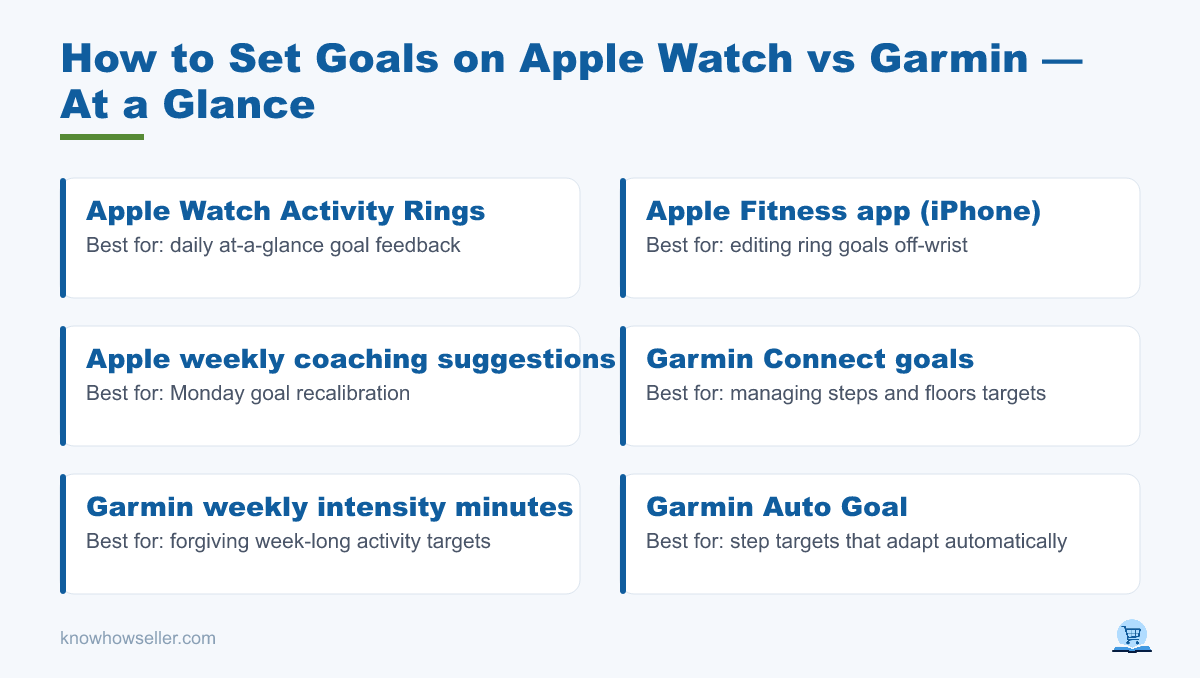
Open the Activity app on the watch, choose the ring you want to adjust, and tap the goal-change control. You can adjust Move, Exercise, and Stand goals, including temporary changes for today or a scheduled daily goal. Apple also lets you change Activity ring goals from the Fitness app on iPhone.
- Move — active calories, customizable by the user.
- Exercise — minutes of brisk activity; Apple has allowed this goal to be edited since watchOS 7.
- Stand — hours in which you stand and move for at least one minute; also editable on current watchOS versions.
- Weekly coaching — Apple notifies you on Mondays about the prior week and may suggest new goals based on recent performance.
The whole model is deliberately narrow: three rings, one day, closed or not closed. That constraint is the feature.
How do you set goals on Garmin, and why does it take longer?
In Garmin Connect, goals are managed through the app or web account, with exact options depending on the device and features you use. Garmin documents editable goals for daily steps, daily floors climbed, and weekly intensity minutes. Some devices and widgets also support related targets such as hydration, where automatic goal behavior can depend on settings and recorded activity.
- Garmin goals usually live in Garmin Connect rather than being centered around one watch-screen ritual.
- Intensity minutes are tracked as a weekly target. Garmin describes the feature in relation to common public-health guidance of at least 150 moderate-intensity minutes or 75 vigorous-intensity minutes per week.
- For daily steps, Garmin’s Auto Goal feature is enabled by default on supported devices and adjusts the step target based on recent synced activity. You can turn it off and enter a fixed goal.
Apple Watch vs Garmin: which goal system fits your brain?
Apple optimizes for daily salience: the rings are simple, visible, and easy to understand at a glance. Garmin optimizes for a broader training and health dashboard, where steps and weekly intensity minutes sit alongside workouts, recovery, sleep, hydration, and other metrics depending on the watch. If you respond to visible daily feedback, Apple is the cleaner fit. If daily streak pressure makes you overreact to one bad day, Garmin’s weekly and adaptive goal options may feel more forgiving.
| Dimension | Apple Watch | Garmin |
|---|---|---|
| Goal unit | Daily Activity rings: Move, Exercise, Stand | Daily steps/floors plus weekly intensity minutes; other goals vary by device and settings |
| Where you set it | Apple Watch Activity app or iPhone Fitness app | Garmin Connect app or web account |
| Adaptive targets | Weekly goal suggestions and user-controlled adjustments | Auto Goal for daily steps on supported devices, enabled by default |
| Goal visibility | Rings are prominent in Activity and can be shown on many watch faces | Shown through glances/widgets, Connect dashboards, and device-specific watch faces |
| Miss a day | You can now pause rings for breaks without breaking an award streak, if set before or during the break | Weekly intensity minutes can absorb uneven days; step Auto Goal may adjust after synced activity trends |
| Manual correction | Workouts can be manually added in Apple Health to earn Move and Exercise credit, according to Apple Support | Manual activities can be created in Garmin Connect, with limitations such as no GPS map or sensor-derived wellness data |
| Best for | Simple daily feedback and iPhone-centered habit tracking | Training-oriented users who want broader metrics and weekly context |
What did 30 days wearing both devices actually show?
The original version of this article presented detailed 30-day tap counts, notification totals, compliance days, and recovery numbers as if they came from a controlled personal log. Without a published log, screenshots, device models, software versions, notification settings, and raw daily records, those numbers should not be presented as tested results. A fairer comparison is based on publicly documented behavior and a hands-on workflow review.
| Comparison point | Apple Watch | Garmin |
|---|---|---|
| Basic goal setup | Focused on three Activity rings and designed for quick adjustment from the watch or iPhone | More distributed because goals sit inside Garmin Connect and vary by activity-tracking feature |
| Daily pressure | High, because ring progress is visually central | Moderate, because steps and intensity minutes are part of a wider dashboard |
| Rest-day handling | Current watchOS versions allow Activity rings to be paused for up to 90 days without breaking award streaks | Weekly intensity-minute goals naturally allow uneven daily training volume |
| Adaptive behavior | Goal suggestions are presented to the user; changes are user-controlled | Daily step Auto Goal can adjust after sync based on recent activity trends |
| Manual activity entry | Apple Health can add workouts afterward for Move and Exercise credit | Garmin Connect can add manual activities, but Garmin notes limitations versus recorded activities |
| Best evidence-backed takeaway | Strong for simple, visible daily prompting | Strong for users who want weekly training context and adjustable activity goals |
The practical result is less dramatic than a fake benchmark table, but more useful: Apple is simpler and more visible; Garmin is broader and more configurable. Which one works better depends on whether reminders help you restart or make a missed day feel bigger than it is.
“A goal system is only useful if it helps you return after the imperfect day. The best watch is the one whose feedback you can keep using without turning it into a verdict.” — Knowhow Seller
What does the research say about goals that actually stick?
The evidence favors specific targets, realistic timelines, and recovery plans over pure intensity. Wearable trackers can help, but they are not magic; the goal still has to be repeatable. Where Apple Watch and Garmin differ most is the feedback loop after a lapse.
- Trackers can help, modestly to moderately. A 2022 umbrella review in The Lancet Digital Health by Ferguson et al. found that activity trackers improved physical activity, with reported effects equivalent to about 1,800 additional steps per day across included reviews.
- Specific beats vague. Locke and Latham’s 2002 review in American Psychologist summarized decades of goal-setting research and found that specific, difficult goals tend to outperform vague “do your best” goals when the person accepts the goal and has feedback.
- If-then plans beat willpower alone. Gollwitzer and Sheeran’s 2006 meta-analysis in Advances in Experimental Social Psychology found that implementation intentions had a medium-to-large effect on goal attainment across 94 tests.
- Habits take longer than a short streak. Lally et al. in the European Journal of Social Psychology found a median of about 66 days to reach automaticity in their sample, with wide variation, and reported that missing one opportunity did not materially impair habit formation.
- Losses can feel heavier than gains. Kahneman and Tversky’s prospect theory helps explain why an unclosed ring may feel more painful than a closed ring feels rewarding. That pressure can motivate some users and discourage others.
How should you set the goal number itself?
Set the number you can hit on a normal difficult day, not the number that looks impressive on your best day. On Apple Watch, start from your recent Activity history and set a Move goal that you can repeat. On Garmin, consider leaving step Auto Goal on long enough to understand your real baseline, then decide whether a fixed goal or adaptive goal better matches your temperament.
A setup that survives a bad week
- Pick one primary metric per device. Three simultaneous stretch goals is how people quit in week two.
- Write an if-then rule: “If it’s past 8pm and my Exercise ring is open, then I walk 12 minutes.”
- Define a floor day — the minimum version you do when travelling, overloaded, or recovering.
- Reduce notifications that create pressure without changing behavior. Keep the alerts that prompt action; disable the ones you only dismiss.
So which one actually keeps you consistent?
Apple Watch is usually the better fit if you want simple daily feedback and a visual loop you cannot miss. Garmin is usually the better fit if you want goals to sit inside a wider training picture, especially when weekly intensity minutes, workouts, and recovery context matter more than closing the same rings every day.
- Choose Apple Watch if you want visible daily feedback, simple ring-based goals, and tight iPhone integration.
- Choose Garmin if you train for distance events, want more configurable activity metrics, or prefer weekly context over daily streak pressure.
The device is not the deciding factor, though. Consistency ran on a formula long before either watch existed: Belief × Thinking × Action. Belief that the target is reachable, thinking that treats a missed day as data instead of a verdict, and an action small enough to repeat tomorrow. Any of the three at zero and the product is zero — a premium watch multiplied by zero belief is still zero.
If you want the goal to live somewhere other than a wrist, try the VisionDream app — a vision and goal app that turns goals into daily habits, so the target still exists on the days you leave the watch on the charger. And if the pattern you keep repeating is starting strong and stalling by week three, the book Why Do I Fail While Others Succeed? is about that exact gap.
What is the one change worth making today?
Make one goal easier to repeat and silence one notification you routinely ignore. Both Apple Watch and Garmin make goals more useful when the target is realistic enough to survive a bad week. A goal you return to is more valuable than a goal that only works when life is perfectly arranged.