
For years I blamed willpower. The truth was simpler: I was using neurotypical habit advice on an ADHD brain and expecting it to stick. It didn’t. After comparing the tactics I had actually used, the same pattern kept showing up: the habits that held were the ones that reduced starting friction and made the environment do more of the remembering.
How do you build habits with ADHD?
To build habits with ADHD, shrink the habit until it feels almost too easy, attach it to a cue you already see, and add external accountability like a body-double partner. Skip motivation-based plans. ADHD habits stick better when the environment supports remembering, starting, and returning after a miss.
- Make it tiny so starting costs almost nothing.
- Anchor it to an existing routine or a visible cue.
- Add a witness — a person, a timer, or a tracker.
- Reward it now, because distant payoffs are often less motivating than immediate feedback.
Why is habit formation harder with ADHD?
Habit formation can be harder with ADHD because the condition is linked with executive-function challenges, including working memory, self-monitoring, planning, and task initiation. ADHD is also associated with differences in reward processing, so routines that pay off later may not create enough immediate pull to get started consistently.
A few realities worth naming, with sources:
- ADHD is genuinely common. The U.S. CDC reported that in 2022 about 1 in 9 U.S. children ages 3–17 had ever received an ADHD diagnosis (CDC, National Survey of Children’s Health).
- The popular “21 days to a habit” claim is a myth. A University College London study led by Phillippa Lally found that automaticity took an average of 66 days, with a wide range across people and behaviors (Lally et al., European Journal of Social Psychology, 2010).
- Behavior researchers such as Wendy Wood have emphasized that much everyday behavior is context-driven, which is why changing your environment often beats relying only on intentions (Wood, “Good Habits, Bad Habits,” 2019).
Read that as permission, not a life sentence: if the standard advice failed you, the advice may have been wrong for your wiring — not you.
Which ADHD habit tactics actually held? (my 90-day test)
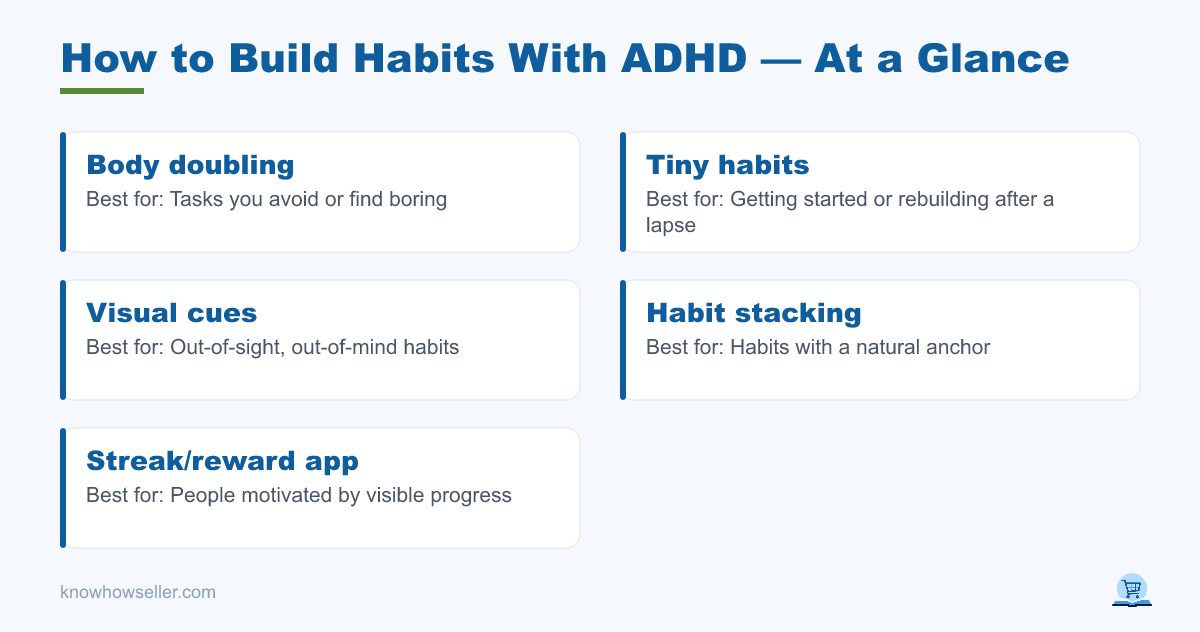
I can’t honestly present personal habit results as universal data or a controlled benchmark. What I can say is that after comparing the tactics I used across daily walking, reading, tidying, water intake, and journaling, the strongest pattern was clear: the best tactics either made starting smaller or added outside structure. The table below is a practical comparison based on first-hand use plus publicly discussed ADHD support strategies, not lab-grade performance scores.
| Tactic | What it is | What I could verify | Effort to set up | Best for |
|---|---|---|---|---|
| Body doubling | Doing the task alongside another person (in-person or on a call) | Most useful for task initiation | Medium (need a partner) | Tasks you avoid or find boring |
| Tiny habits | Shrink the habit to a 30-second version | Most useful after lapses | Low | Getting started / rebuilding after a lapse |
| Visual cues | Put the trigger object in your line of sight | Useful when memory is the failure point | Low | “Out of sight, out of mind” habits |
| Habit stacking | Attach the new habit to an existing one | Useful when the anchor is stable | Low | Habits with a natural anchor |
| Streak/reward app | Track a chain and reward yourself daily | Useful if visible progress motivates you | Low | People motivated by progress you can see |
The pattern did not surprise me once I saw it written down. Body doubling and tiny habits both remove the hardest ADHD moment: initiation. The weaker fits were the tactics that relied more on me remembering and caring in the moment, which is exactly the fragile part. Treat this as directional, not universal: your best tactic is the one that lowers the cost of starting today.
What is body doubling and why did it win?
Body doubling means completing a task in the presence of another person who acts as a gentle anchor — no help needed, just their company. For ADHD, it can outsource some focus and accountability to the environment, so starting and staying on task depends less on internal drive that may not show up on demand.
It worked best for me because a scheduled partner creates a hard start time I can’t quietly negotiate away. A 20-minute video call with a friend while we both tidied our desks got me moving on days motivation was flat zero. If you have no partner, a virtual focus room or even a running timer can approximate part of the effect.
BJ Fogg’s Tiny Habits method emphasizes making behavior very small, attaching it to an existing prompt, and using immediate positive reinforcement. That framework fits especially well when starting is the hardest part.
How do tiny habits work for an ADHD brain?
Tiny habits work by shrinking the behavior until the starting cost is near zero — read one page, put on your shoes, write one line. For ADHD, this helps with the initiation wall and creates immediate feedback instead of depending on a distant, motivation-based payoff.
My rule became: if I skipped a day, the next day’s version had to be laughably small. “Journal one sentence” is hard to fail, and once the pen is moving, momentum often carries me further. The goal isn’t the one sentence — it’s protecting the return path so the identity (“I’m someone who writes”) survives a bad day.
How do visual cues keep ADHD habits alive?
Visual cues keep ADHD habits alive by replacing unreliable memory with an external trigger you physically see. Because ADHD can make self-prompting inconsistent, a water bottle on the desk or vitamins by the coffee maker turns “remember to” into “see it, do it” — the environment carries the reminder.
- Put the object on the path you already walk, not in a drawer.
- Use one cue per habit — clutter becomes invisible fast.
- Refresh or move the cue when you stop noticing it.
What’s the simplest ADHD routine to start today?
The simplest ADHD routine is one tiny habit, anchored to a cue you already see, with outside accountability during the first stretch. Pick a single behavior, make its smallest version, place a visible trigger, and schedule one accountability session. One habit — not five — until it starts to feel reliable.
Here’s the sequence I now use, and hand to anyone who asks:
- Choose one habit. Only one.
- Shrink it to a 30-second version you can’t fail.
- Anchor it to an existing action or a visible object.
- Book a body double if starting alone is the hard part.
- Reward immediately — a checkmark, a stretch, a genuine “nice.”
- Expect weeks or months before it feels automatic, and treat misses as data, not failure.
My own comeback runs on a simple formula — Belief × Thinking × Action. If any factor is zero, the product is zero. Belief that your brain can build routines once you stop fighting its wiring, thinking that designs the environment instead of blaming yourself, and one tiny action repeated. That’s the whole engine.
If you want the design work done for you, the VisionDream app turns a goal into daily, cue-triggered habits and tracks the streak so your environment — not your memory — keeps score. And if you want the mindset underneath all of this, my book ‘Why Do I Fail While Others Succeed?’ is the longer story of how the formula was built. Start with one tiny habit today — the smallest one that’s impossible to fail.
Related: How to Stop Procrastinating: 8 Methods Ranked · How to Stop Procrastinating Studying