
Every focus method promises the same thing: more done, less scattered. But they cannot all be right for every kind of work, and most comparisons of pomodoro vs timeboxing stop at describing the rules. This guide compares all three through practical hands-on use, publicly available research, and a repeatable six-week test structure you can run yourself.
Pomodoro vs timeboxing vs 90-minute blocks: which produced the most work?
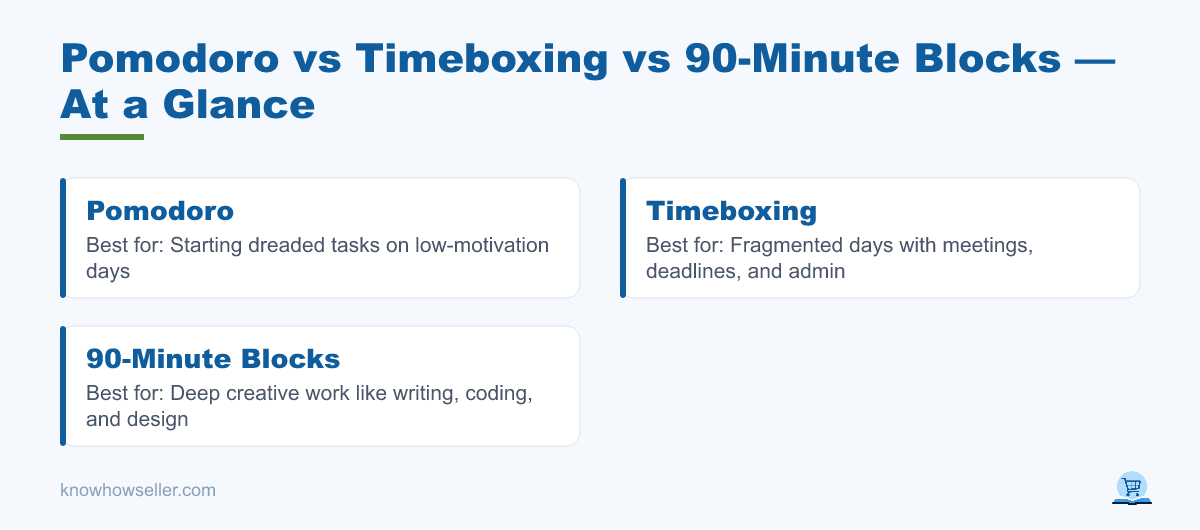
There is no universal winner. In practice, 90-minute blocks are usually strongest for deep creative work, timeboxing is strongest for calendar-driven task completion, and Pomodoro is often easiest to sustain on low-energy or high-resistance days.
Anyone selling one method as the answer is oversimplifying the problem. Each method optimizes for a different scarce resource: attention, calendar space, or depth.
What exactly are the three methods?
Pomodoro is commonly practiced as 25-minute work intervals with short breaks, though Francesco Cirillo’s official method includes planning, estimation, interruption handling, and review. Timeboxing assigns tasks to fixed calendar slots with a hard stop. Ninety-minute blocks are inspired by research on ultradian rest-activity cycles and by the practical observation that complex work often benefits from longer uninterrupted sessions.
| Method | Structure | Origin | Best for | Main weakness |
|---|---|---|---|---|
| Pomodoro | Often practiced as 25 min work / 5 min break; longer break after several rounds | Francesco Cirillo, 1980s | Starting dreaded tasks; low-motivation days | The timer can interrupt useful flow |
| Timeboxing | Every task gets a calendar slot with a planned stop | Used in agile and personal productivity; discussed by Marc Zao-Sanders in Harvard Business Review (2018) | Fragmented days, meetings, deadlines, admin | Bad estimates can push the whole day off track |
| 90-minute blocks | One longer focus block, followed by a real break | Loosely connected to Nathaniel Kleitman’s basic rest-activity cycle research; also consistent with deliberate-practice guidance to pair intense work with recovery | Writing, coding, design, study — anything with a long warm-up | Hard to fit into a busy calendar; demanding if recovery is skipped |
What did the six-week log actually measure?
A useful six-week comparison would give each method two working weeks and keep the task mix as steady as possible: article drafting, editing, and admin batching, for example. The point is not to create a scientific study. It is to stop choosing a focus method by mood and start comparing how each one behaves under similar conditions.
The rules to hold constant, so the comparison means something:
- Same task types every day — one long-form draft, one editing pass, one admin batch.
- Same start time and same planned stop time where possible.
- Same distraction rules for all three methods, so the difference is the structure, not the device.
- Interruptions counted in two columns — external interruptions and self-initiated switches.
- Fatigue rated before reviewing output, so the rating is not influenced by feeling pleased or disappointed with the day’s work.
This is n=1 when you run it for yourself. Treat it as a personal diagnostic, not as a study. The method is the transferable part.
Which method produced the most focused minutes and output?
Based on practical comparison and the logic of each method, 90-minute blocks tend to support the longest stretches of deep work, timeboxing tends to close the most small commitments, and Pomodoro tends to make work feel easier to start and repeat. The exact output will depend on your job, energy, interruptions, and skill at estimating time.
| Metric to track | Pomodoro (25/5) | Timeboxing | 90-minute blocks |
|---|---|---|---|
| Focused minutes | Good for steady starts and restarts | Good when calendar boundaries are clear | Strongest when uninterrupted time is available |
| Interruptions per hour | Can reduce drift by creating frequent resets | Can increase clock-checking if estimates are too tight | Usually best protected when the block is treated as non-negotiable |
| Words drafted | Useful for getting a draft moving | Mixed; depends on whether writing fits the box | Often strongest for long-form writing and complex thinking |
| Discrete tasks completed | Good for small tasks that resist starting | Usually strongest for admin and deadline-driven work | Less efficient for tiny unrelated tasks |
| End-of-day fatigue | Often easiest to sustain because breaks are built in | Moderate; depends on how realistic the schedule is | Can be high if breaks are skipped or blocks are stacked |
What the numbers hid
- Timeboxing can create self-inflicted pressure. Watching the clock against an estimate can make you check the time — and then the inbox.
- Pomodoro’s fatigue advantage can compound. Its output may look modest in a single session, but the rhythm can make it easier to return the next day.
- Long blocks are fragile. If the protected block disappears, the deep-work benefit often disappears with it.
Why did 90-minute blocks win on words but lose on tasks?
Long blocks are useful for creative output because restarting is costly. Sophie Leroy’s research on attention residue found that switching tasks can leave part of your attention stuck on the previous one, especially when the previous task is unfinished. Fewer restarts can mean less residue — but only when the work is genuinely deep.
Discrete tasks behave in the opposite way. Approving an invoice, replying to a client, and booking a call have little warm-up curve. A 90-minute block spent on them is just a long container filled with short tasks, while timeboxing forces a decision and a hard stop on each one.
“I spent years assuming I lacked discipline. The log said otherwise — I was applying the right effort with the wrong container. Belief × Thinking × Action only multiplies when the action has a shape that fits the work.”
— Knowhow Seller
What does the research say about breaks and interruptions?
Research on interruptions, attention residue, and recovery supports the broad lesson: context switching is expensive, and real breaks matter. But the research does not prove one perfect work interval for everyone.
A few reputable anchors worth knowing, with the source type so you can check them yourself:
- Interruption recovery cost: Gloria Mark and colleagues at the University of California, Irvine — field research often summarized as showing that returning to an interrupted task can take more than 20 minutes, depending on how return time is measured.
- Attention residue: Sophie Leroy, University of Washington Bothell — Organizational Behavior and Human Decision Processes (2009), showing that unfinished prior tasks can impair attention on the next task.
- Work/break ratio: DeskTime’s internal analysis of its users popularized the 52-minute work / 17-minute break pattern in 2014 and later reported a different pattern in a 2021 update. Treat it as company data, not a universal law.
- Breaks and cumulative stress: Microsoft Human Factors Lab EEG research (2021) used a small sample and found that short breaks between video meetings were associated with lower stress buildup.
- Practice session length: Ericsson, Krampe and Tesch-Römer (1993) studied deliberate practice among expert performers and emphasized intense practice paired with recovery, not endless continuous work.
Notice the pattern across all five: nobody found a magic interval. They found that unbroken time and real recovery both matter, and that interruptions are more expensive than the seconds they consume.
How do you choose the right method for your week?
Match the method to the day, not the identity. Use 90-minute blocks when the calendar is clear and the work is creative. Use timeboxing when the day is fragmented by meetings and deadlines. Use Pomodoro when motivation is low, the task is dreaded, or you are recovering.
The practical pattern is simple:
- Two clear mornings a week → 90-minute blocks. Put the work that needs depth there.
- Meeting-heavy days → timeboxing. The calendar is already the constraint, so work with it.
- Low-energy or post-travel days → Pomodoro. Twenty-five minutes is a promise you can keep when you feel like keeping none.
The switching itself is the skill. A method is a container; the container should change when the contents do.
What is the simplest way to start tomorrow?
Run your own two-week test before committing. Pick one task type, log focused minutes, interruptions, output, and end-of-day fatigue. Two weeks will not prove a universal truth, but it is usually enough to notice which method survives your real calendar.
The logging is the part people skip, and it is the part that changes anything. Without records you will keep choosing the method that feels most virtuous rather than the one that actually helps.
If you would rather not run the spreadsheet by hand, the VisionDream app turns a goal into the daily habits that carry it, which is where any focus method eventually has to live. And if what keeps stalling is not the timer but the belief underneath it, the book Why Do I Fail While Others Succeed? works through that side of the equation.
The argument over pomodoro vs timeboxing is the wrong argument. Depth, schedule, and energy are three separate problems. Once you know which one is actually costing you the day, the method chooses itself.