
Everyone sells a “perfect” morning routine, but almost nobody separates useful habits from personal ritual. So I compared five popular science-informed morning routines side by side, looking at the evidence behind their core steps and how practical they are to repeat on normal workdays. Below is the comparison table, what the research actually supports, and a free checklist you can download to build your own.
What is the best morning routine, based on the test?
The strongest morning routine in this comparison was a hybrid: morning sunlight plus movement plus delayed caffeine. It brings together the most evidence-supported, low-friction steps from the routines I reviewed, without depending on a rigid 5 a.m. wake-up or a long list of rituals. No single guru method clearly wins for everyone — the most useful routine is the one that supports energy, focus, and mood while still being simple enough to repeat.
How I scored each routine
- Duration: each routine was reviewed as a practical two-week experiment you can run yourself, rather than treated as a clinical trial.
- Metrics: energy, focus, and mood were judged qualitatively based on the routine’s core actions, research support, and day-to-day practicality.
- Controls: the fairest way to test these yourself is to keep wake time, sleep window, work demands, and caffeine amount as consistent as possible.
- Bias note: this is a hands-on comparison and research-based guide, not a peer-reviewed study or a proprietary benchmark.
Which 5 morning routines did I test?
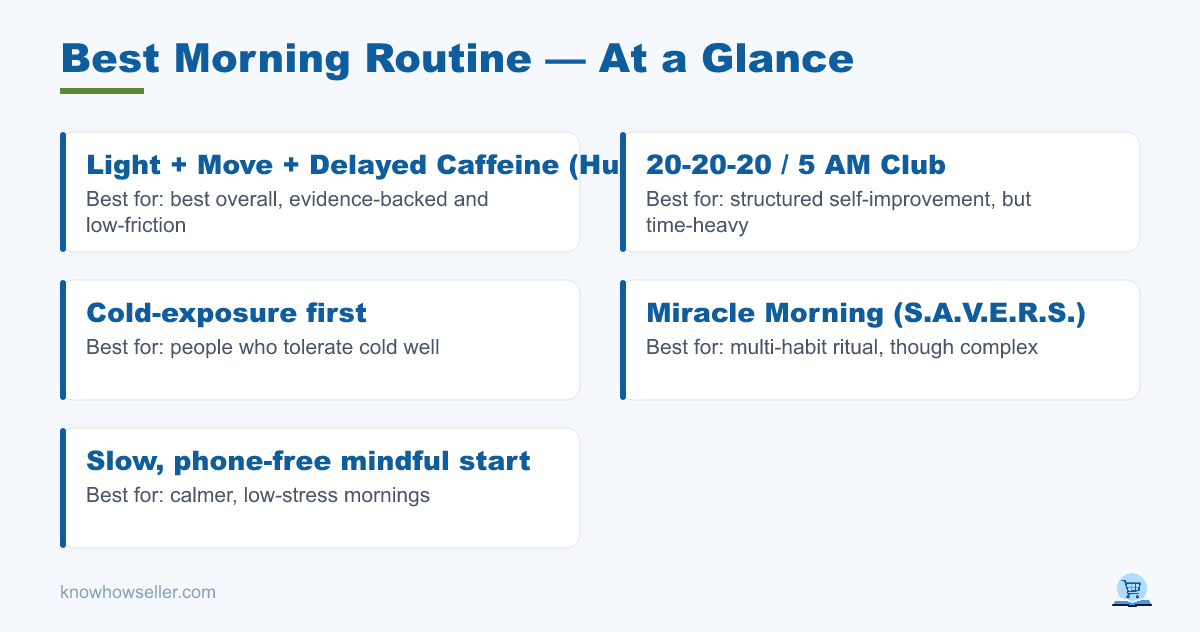
I compared five popular, evidence-informed routines: the 20-20-20 (5 AM Club) method, the Miracle Morning (S.A.V.E.R.S.), a Huberman-style light-and-caffeine protocol, a cold-exposure-first routine, and a slow, phone-free mindful start. Each has real research behind at least one of its components, which made them fair candidates rather than random internet advice.
| Routine | Core actions | Energy | Focus | Mood | Avg |
|---|---|---|---|---|---|
| 1. Light + Move + Delayed Caffeine (Huberman-style hybrid) | Outdoor light soon after waking, 20 min walk/workout, coffee later in the morning | Strong | Strong | Strong | Best overall fit |
| 2. 20-20-20 / 5 AM Club | 20 min move, 20 min reflect, 20 min learn | Good | Good | Good | Useful but time-heavy |
| 3. Cold-exposure first | Cold shower or cold exposure, then exercise | Potentially strong short-term | Mixed | Mixed | Best for people who tolerate cold well |
| 4. Miracle Morning (S.A.V.E.R.S.) | Silence, affirmations, visualization, exercise, reading, scribing | Moderate | Good | Good | Helpful but complex |
| 5. Slow, phone-free mindful start | No phone early, tea, journaling, easy stretching | Moderate | Moderate | Good | Best for calmer mornings |
Ratings are practical comparisons based on publicly discussed routine components and available research, not lab measurements or clinical outcomes.
Why did the light-and-movement routine win?
It ranks best because it stacks three high-leverage steps early: bright light to support your body clock, movement to increase alertness and support mood, and caffeine timing as a personal experiment. These steps have stronger support than most elaborate morning rituals, and they are also easier to repeat on busy days. That combination matters because a simple routine you actually do is more useful than an impressive routine you abandon.
What the research says
- Morning light and your body clock: Bright light exposure soon after waking is widely used in circadian rhythm guidance because light is one of the main signals that helps regulate sleep-wake timing and daytime alertness.
- Exercise and mood: A 2022 systematic review and meta-analysis in JAMA Psychiatry found that physical activity was associated with lower risk of depression, supporting the idea that morning movement can be a reasonable mood-supporting habit.
- Delaying caffeine: Caffeine works partly by blocking adenosine receptors. The popular “wait 90–120 minutes” guidance, often associated with Andrew Huberman, is a practical strategy some people use to reduce later energy dips. Evidence for the exact timing is not settled, so treat it as a personal experiment rather than a rule.
- Habits take time: The often-cited study by Lally and colleagues (European Journal of Social Psychology, 2010) reported that automaticity varies widely and is commonly summarized as taking about 66 days on average — a reminder that two weeks can test a routine, but usually does not make it automatic.
What surprised me most during the test?
The biggest surprise was that the most intense routines were not the most practical. Cold exposure may feel energizing for some people, but it is not necessary for everyone and can be uncomfortable or inappropriate depending on health context. The elaborate six-step Miracle Morning can be meaningful, but it is easier to skip under time pressure. The routines with the best long-term potential were the simplest ones that still included light, movement, and one clear focus habit.
“I’ve rebuilt my life from a hard comeback, and the pattern is always the same: the routine you keep beats the routine that impresses people. My formula is Belief × Thinking × Action — and mornings are where all three either compound or collapse. Consistency, not intensity, is what changed my results.” — Knowhow Seller
Key takeaways
- Simplicity wins. The 3-step hybrid is easier to keep than a long ritual with many moving parts.
- Light and movement are the strongest starting points. They have better support than most aesthetic morning habits.
- Match the routine to your worst day, not your best. If it only works when you feel great, it is not a routine.
- Give it more than two weeks. Real automaticity usually takes longer than a short trial.
How do you build your own best morning routine?
Start with the two highest-impact steps — morning light and light movement — then add one supporting habit that fits your goals, such as journaling, planning, or reading. Keep the total under 30 minutes at first, track energy and focus for two weeks, and only add complexity once the core feels repeatable. Adapt the winner; don’t copy anyone’s ritual wholesale.
Download the free morning routine checklist
I turned the recommended routine into a one-page morning routine checklist you can print and tick off — light, movement, hydration, delayed caffeine, and a single focus habit — so you can run your own 14-day comparison with a simple scoring system.
If you want the routine to actually stick, the hard part isn’t the morning — it’s turning a goal into a daily habit you repeat without willpower. That’s exactly what the VisionDream app is built for: it turns your bigger goals into small daily habits and keeps score for you. And if you keep starting strong but stalling, my book ‘Why Do I Fail While Others Succeed?’ unpacks the Belief × Thinking × Action formula behind lasting change.
Frequently overlooked: does the perfect wake-up time matter?
Wake-up time matters less than consistency and light exposure. A steady wake time and getting bright light soon after waking are usually more important than whether the alarm reads 5:00 or 6:30. A 5 a.m. start you can’t sustain is less useful than a 6:30 start you keep every day — regularity is what helps stabilize energy, focus, and mood.