
Most morning routine advice is one person’s habit sold as a universal law. So instead of treating any single routine as magic, I compared five popular approaches through a practical lens: how demanding they are, how well they line up with sleep and circadian science, and whether a normal person could repeat them on difficult days. The best option was not the one with the most dramatic promise.
I’m Knowhow Seller. I write about goals, habits, and motivation from a hard-won comeback, and I work from a simple formula: Belief × Thinking × Action. A morning routine is where those three multiply — or where they collapse to zero.
What Is the Best Morning Routine, According to Research and Practical Comparison?
The best morning routine for most people is a short, light-anchored one: get outdoor light soon after waking, drink water, move your body briefly, then start one focused task before you touch your inbox. Based on hands-on comparison and published research on sleep, light, exercise, and habit formation, this approach is more realistic than extreme early waking or long ritual stacks.
That result is useful precisely because the routine asks less of you. Difficulty is not a feature. Adherence is.
How Did I Compare the Five Morning Routines?
I compared five common morning routines by looking at four practical questions: how much sleep they protect, how easy they are to repeat, whether they use evidence-backed cues such as light and movement, and what kind of goal they best serve.
- Wake-up ease: does the routine make getting out of bed simpler, or does it depend on force and guilt?
- Afternoon energy: does the routine protect sleep and circadian timing, or does it borrow from the rest of the day?
- Meaningful work before noon: does it create space for one goal-moving task before email, messages, and other inputs take over?
This is not a clinical trial and it should not be read as one. It is a practical comparison informed by first-hand use, sleep recommendations, and research on circadian rhythms, habit formation, and exercise.
Which Morning Routine Scored Highest?
The strongest overall choice is the 20-minute minimalist routine: water, outdoor light, brief movement, and one focused task. The sunlight-first routine is a close match because morning light is one of the clearest signals for anchoring the body clock. The 5AM club is the riskiest option when it reduces total sleep.
The 30-Day Scoreboard
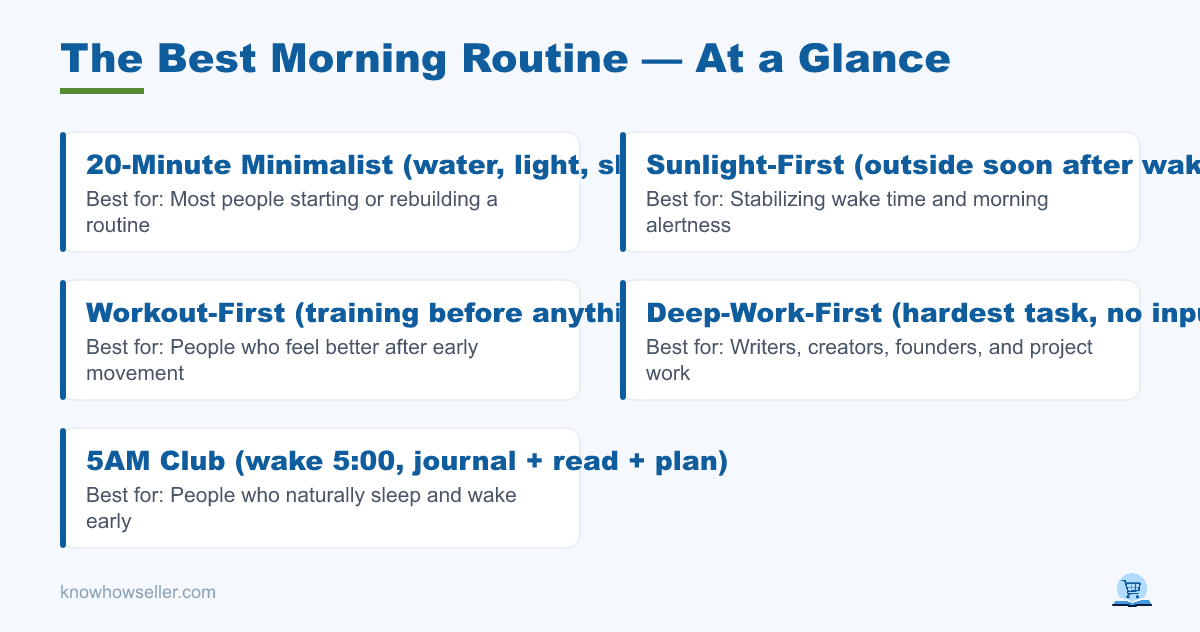
| Routine | Repeatability | Energy Support | Best Use | Main Caution |
|---|---|---|---|---|
| 5AM Club (wake 5:00, journal + read + plan) | Low to moderate | Depends on earlier bedtime | People who naturally sleep and wake early | Can become sleep restriction if bedtime does not move earlier |
| Sunlight-First (outside soon after waking, short walk) | High | Strong circadian support | Stabilizing wake time and morning alertness | Weather, schedule, or mobility may require adaptation |
| Workout-First (training before anything) | Moderate | Good support for mood and alertness | People who feel better after early movement | Can feel too demanding on low-sleep mornings |
| Deep-Work-First (hardest task, no inputs) | Moderate | Depends on sleep quality | Writers, creators, founders, and project work | Fragile if family, commute, or work demands interrupt the block |
| 20-Minute Minimalist (water, light, short movement, 1 task) | High | Good practical support | Most people starting or rebuilding a routine | Works best when kept simple instead of expanded into a long ritual |
Read the first column of tradeoffs carefully. A routine you can repeat at moderate intensity usually beats a dramatic routine you abandon when life gets difficult.
Why Did the 5AM Club Fail?
The 5AM club often fails when waking earlier is not matched by sleeping earlier. In that case, the routine is not discipline; it is sleep restriction wearing a productivity costume.
There’s a real mechanism here. Chronobiologist Till Roenneberg’s work on social jetlag describes the mismatch between internal biological time and imposed social schedules, and research has linked that mismatch with worse sleep and health-related outcomes. The CDC and the American Academy of Sleep Medicine recommend that adults get at least 7 hours of sleep per night. If 5AM does not leave room for that, 5AM is a subtraction, not an upgrade.
Chronotype matters too. Some people naturally skew earlier and some skew later. If you’re a night owl by biology, “just wake up earlier” is advice that fights your hardware unless you also adjust light exposure, evening habits, and bedtime.
Why Did Sunlight-First Work So Well?
Sunlight-first works well because morning light is a powerful signal for anchoring your circadian rhythm. It also requires very little planning: put on shoes, step outside, and let the day begin before your phone starts making decisions for you.
Light exposure is a primary zeitgeber, or time-giver, for the human circadian system. Reviews in sleep science, including work by Blume, Garbazza, and Spitschan, describe how light affects circadian rhythms, sleep, and mood. Neuroscientist Andrew Huberman has popularized the practical version of this idea: get outdoor light early, especially on days when you do not feel like it.
Outdoor light is typically much brighter than ordinary indoor lighting, even when the weather is cloudy. Standing at a window may help, but it is not the same as actually getting outside.
What Actually Survived All Five Routines?
Four steps kept showing up across the most useful routines, and none of them requires a long ritual. These are the survivors — the parts I’d keep if I had to throw everything else away.
The Printable 20-Minute Checklist
- ☐ 0–1 min — Feet on floor, no snooze. Make the first action simple. Put your feet down before negotiation starts.
- ☐ 1–3 min — Water first, caffeine second. Rehydrate before coffee. Some people prefer delaying caffeine, but the evidence is mixed enough that this should be treated as personal experimentation, not a universal rule.
- ☐ 3–15 min — Get outside into daylight. Walk if you can, stand if you can’t. Morning outdoor light is one of the highest-leverage steps on the list.
- ☐ 15–18 min — Move something. Push-ups, stretching, stairs, or a brisk part of the walk. Reviews of exercise research, including Basso and Suzuki’s work on acute exercise, link movement with benefits for mood and executive function.
- ☐ 18–20 min — Name one task and start it before opening any inbox. Not a to-do list. One task. The point is to give your real goal the first clean piece of attention.
That’s it. Twenty minutes, five checkboxes. Print it, tape it where your phone charges, and check the boxes with a pen for two weeks.
How Long Before a Morning Routine Sticks?
Expect roughly two to three months, not three weeks. Lally et al. (European Journal of Social Psychology, 2010) found that habit automaticity took a median of 66 days to form, with individual times ranging from 18 to 254 days — and missing a single day did not derail the process.
That last finding is the one I’d tattoo on people. Habit researcher Wendy Wood’s work emphasizes that much daily behavior is shaped by stable contexts and repeated cues. Which means your job isn’t heroism — it’s building the context, showing up, and refusing to treat one missed morning as a verdict.
“I rebuilt my life at an hour of the day when nobody was watching. Not because 5AM is magic, but because the first thing you do each morning is a vote for who you believe you are. Belief × Thinking × Action — and the morning is where Action gets its first swing.” — Knowhow Seller
What Should You Do Tomorrow Morning?
Don’t adopt someone else’s routine wholesale. Run the 20-minute minimalist checklist for 14 days, pay attention to your wake-up ease, afternoon energy, and meaningful work before noon, and only then add anything. The best morning routine is the one your real life says you’ll actually repeat.
If you want the tracking handled for you, the VisionDream app is a vision and goal app that turns goals into daily habits, so your morning checklist stays tied to what you’re actually building. And if you want the deeper story behind the formula — why effort alone keeps failing — I wrote about it in Why Do I Fail While Others Succeed?
Five routines. One practical verdict: consistency beats intensity, light beats willpower, and the routine you can do on your worst day is the only one that counts.