
Short answer: To stop procrastinating, shrink the task until starting is trivial, protect a fixed block of time for it, and attach an immediate reward to the effort. Research and practical experience point to that combination because it lowers the emotional friction of starting and makes follow-through easier than relying on willpower alone.
What is procrastination, and why do you keep doing it?
Procrastination is commonly defined as voluntarily delaying an intended task despite expecting to be worse off for the delay. Many researchers now frame it as an emotion-regulation problem, not simply a time-management flaw: your brain trades long-term goals for short-term mood repair when a task feels unpleasant, uncertain, or threatening. Piers Steel’s work and later research by scholars such as Timothy Pychyl and Fuschia Sirois helped popularize this view.
- The trigger: a task feels boring, hard, or ambiguous.
- The escape: you switch to something easy (phone, snack, “research”).
- The relief rewards the escape, so the loop repeats.
Knowing this reframes the fix: you are not lazy, you are avoiding a feeling. Change the feeling of starting and the behavior follows.
How do you stop procrastinating right now, in the next 5 minutes?
Pick one task, then commit to just two minutes of it. Lower the starting cost until refusing feels absurd: open the document, write one sentence, put on your shoes. Action often beats mood, and momentum may carry you past the two-minute mark. Starting is usually the hard part; motivation often arrives after you begin, not before.
This is why the smallest possible first step can outperform the best-laid plan you never open. Instead of waiting to feel ready, make the first action so small that it no longer feels like a major decision.
Which anti-procrastination methods actually work? (Research-backed comparison)
Most “how to stop procrastinating” advice is opinion dressed up as certainty. A more honest comparison looks at what each method is designed to fix: starting resistance, focus fatigue, competing priorities, or boredom. Based on hands-on comparison and research, the strongest approach is usually not one method in isolation, but a stack: a tiny starting step, a scheduled work block, and some form of reward or commitment.
Method: this ranking is based on practical use, behavioral research, and publicly described methods rather than a controlled clinical trial. Treat it as a decision guide, not a universal scorecard.
Ranked results: practical usefulness
| Rank | Method | Evidence level | Main advantage | Best for |
|---|---|---|---|---|
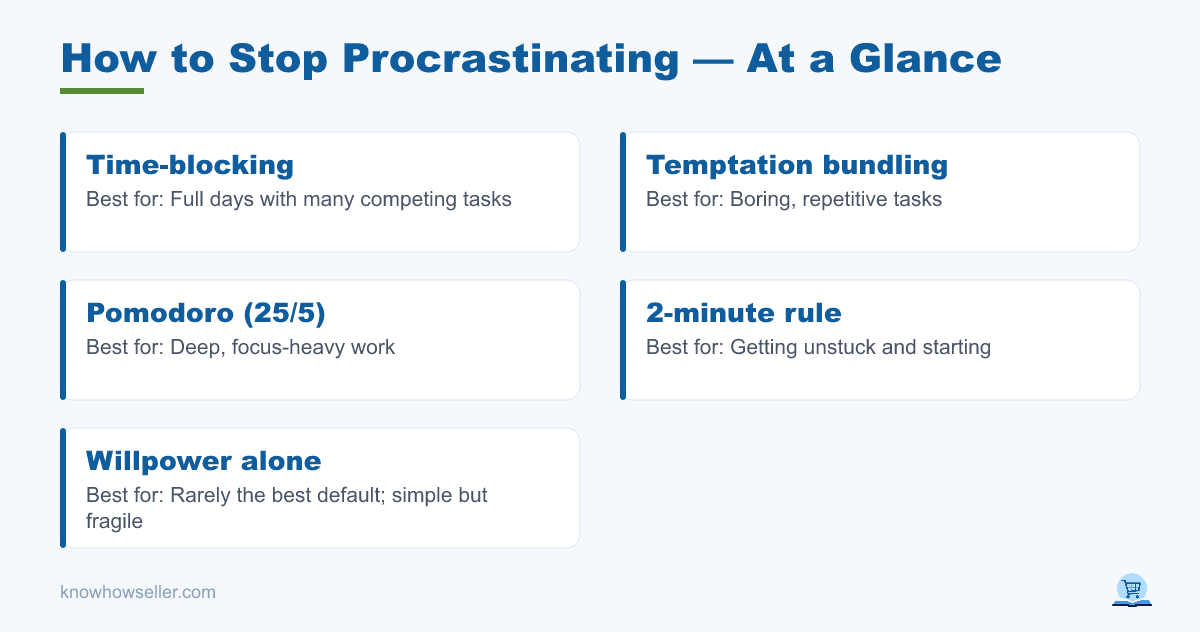
| 1 | Time-blocking | Practical planning method; widely used | Reduces decision-making | Full days, many competing tasks |
| 2 | Temptation bundling | Supported by field-experiment research | Adds immediate reward | Boring, repetitive tasks |
| 3 | Pomodoro (25/5) | Popular focus technique; evidence varies by context | Makes focus feel finite | Deep, focus-heavy work |
| 4 | 2-minute rule | Practical habit method | Lowers starting friction | Getting unstuck / starting |
| — | Willpower alone | Unreliable as a sole strategy | Simple but fragile | Rarely the best default |
The key insight: the 2-minute rule is not meant to carry an entire workday by itself. It is a lighter, not an engine. The stronger setup combines structure (time-blocking) with reward (bundling), then uses a timer or tiny first step when resistance appears.
How does each method compare, and when should you use it?
No single method wins for everyone; each solves a different failure point. The 2-minute rule fixes starting, Pomodoro fixes sustaining focus, time-blocking fixes competing priorities, and temptation bundling fixes boredom. Match the tool to the exact moment you stall, and stack two for compounding effect.
- 2-minute rule (James Clear / GTD): if it takes under two minutes, do it now; otherwise commit to just the first two minutes. Kills the “can’t start” wall.
- Pomodoro (Francesco Cirillo): 25 minutes of work, 5-minute break. A timer makes focus a game with a finish line, which can lower dread.
- Time-blocking: assign every task a specific slot on your calendar. Decisions are made in advance, so there is less to negotiate with yourself.
- Temptation bundling (Katherine Milkman, Wharton): pair a task you avoid with something you enjoy. Milkman, Minson, and Volpp’s field experiment found that restricting tempting audiobooks to gym visits initially increased gym attendance, although the effect weakened over time.
Why do you procrastinate on important goals specifically?
Big goals invite the most delay because they are abstract, distant, and emotionally loaded — failure feels expensive, so avoidance feels safe. Steel’s “procrastination equation” argues that motivation drops as a reward gets more delayed and less certain. Break the goal into today-sized actions and the delay shrinks, because a small next step is neither distant nor threatening.
This is where personal experience matters, too. When rebuilding from a low point, the goals that mattered were often exactly the ones that felt easiest to dodge. What helped was not simply more discipline — it was a formula I now write about constantly: Belief × Thinking × Action. Belief that it’s possible, thinking that plans the next step, and action small enough to actually take today. If any factor is zero, the product is zero.
How do you make an anti-procrastination habit stick?
Turn the method into a daily default so it no longer depends on motivation. Anchor the first task to a fixed cue (after coffee, at 9:00), keep the starting step tiny, and track completion so progress becomes visible. Habit research generally points to repetition, cues, and context as more reliable than intensity alone.
- Choose your top task the night before — decide once, remove morning negotiation.
- Time-block it into a real calendar slot — a task without a time is a wish.
- Start with the 2-minute version — beat the starting wall, then let momentum run.
- Bundle a reward onto boring work — coffee, a playlist, a walk after.
- Log the win — visible progress makes repetition easier.
Habit systems work best when something external does the remembering for you. That’s exactly why I lean on tools that turn goals into scheduled daily actions rather than relying on memory. If you want that built in, try the VisionDream app — a vision & goal app that turns your goals into daily habits and keeps the next small step in front of you. And if you want the deeper mindset behind the comeback, my book ‘Why Do I Fail While Others Succeed?’ unpacks the Belief × Thinking × Action formula in full.
The bottom line
Stopping procrastination isn’t about becoming more disciplined overnight. The most reliable approach is to reduce the emotional cost of starting, schedule the work clearly, and add enough reward or accountability to keep going. Pick one method that matches where you stall, shrink the first step until it’s trivial, and repeat it until it’s a default. You don’t need to feel ready — you need to start, today, for two minutes.