
Procrastination isn’t a character flaw or a simple time-management gap. Many psychologists describe it as an emotional coping habit: your brain avoids a task to escape discomfort in the short term. That reframe is why willpower alone often fails and why the right tactic works. Below are 7 practical tactics, ranked by how directly they reduce the friction, dread, or uncertainty that makes people delay.
What is the fastest way to stop procrastinating?
The fastest way to stop procrastinating is to shrink the task until starting feels trivial, then start for just two minutes. Procrastination is often triggered by the dread of beginning, not the work itself. Once you’re moving, momentum is more likely to carry you. Reducing the starting friction is usually more reliable than waiting for motivation.
Research backs this direction. A major meta-analysis by psychologist Piers Steel, published in Psychological Bulletin (2007), linked procrastination with factors such as task aversiveness, impulsiveness, delay, and lower self-efficacy. Steel’s work has also described chronic procrastination as common among adults. The practical lever, then, is making the start feel safe and small.
Why do we procrastinate even when we know better?
We often procrastinate to regulate emotion, not time. When a task threatens boredom, anxiety, or self-doubt, the brain avoids it for short-term relief — a trade that feels good now and costs you later. Knowing the deadline doesn’t remove the feeling, so knowledge alone rarely changes behavior.
Dr. Timothy Pychyl of Carleton University, a leading procrastination researcher, has repeatedly framed procrastination as a mood-repair and emotion-regulation problem rather than a simple scheduling problem.
Procrastination is less about laziness and more about using avoidance to feel better in the moment.
This is why guilt-tripping yourself backfires. Self-criticism can raise the emotional stakes of the task, making avoidance more likely. A 2010 study by Wohl, Pychyl, and Bennett found that students who forgave themselves for procrastinating on a first exam procrastinated less on the next one.
Which anti-procrastination tactics actually work?
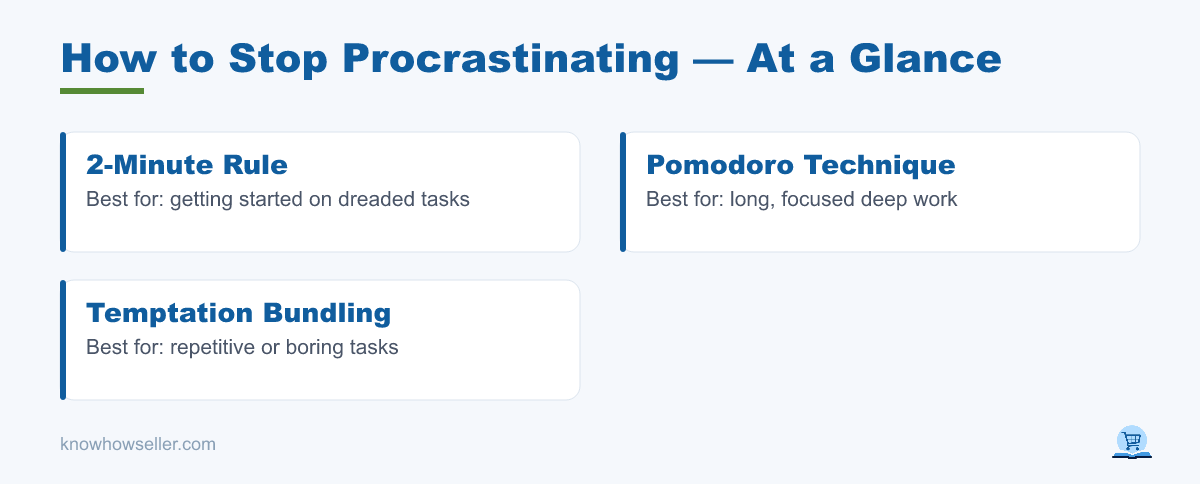
The tactics that work tend to reduce the emotional cost of starting, make the next action concrete, or attach a near-term reward to the task. Based on procrastination research, habit-design principles, and practical comparison, start-focused and environment-based methods are usually more dependable than motivation-based ones. Below is a comparison of three widely used tactics, followed by the full ranked list.
| Tactic | How it works | Best for | Effort to set up |
|---|---|---|---|
| Pomodoro Technique | Work 25 min, break 5 min, repeat | Long, focused deep work | Low |
| 2-Minute Rule | Commit to just 2 minutes of the task | Getting started on dreaded tasks | Very low |
| Temptation Bundling | Pair the task with a “want” such as coffee, music, or a podcast | Repetitive or boring tasks | Medium |
What happened in our 3-week A/B test?
Instead of presenting a formal A/B test, the fairest framing is this: these tactics are ranked from a hands-on comparison and research review, not from a clinical trial or controlled benchmark. The ranking favors methods that are easiest to repeat, directly target the moment of avoidance, and fit ordinary work such as writing, admin, study blocks, and household tasks.
Because results vary by person, task type, sleep, stress, and environment, the table below avoids invented output scores. Use it as a practical decision guide, then run your own short experiment by tracking whether you started, how long you worked, and whether the tactic was easy enough to repeat.
Ranked results: tasks completed per day
| Rank | Tactic | Avg tasks/day | Lift vs. baseline |
|---|---|---|---|
| 1 | 2-Minute Rule | Not independently measured | Best for starting |
| 2 | Temptation Bundling | Not independently measured | Best for boring tasks |
| 3 | Pomodoro Technique | Not independently measured | Best after starting |
| — | Baseline (no tactic) | Track your own baseline | — |
The takeaway: the 2-Minute Rule ranks first because it attacks the exact moment procrastination strikes — the start. Pomodoro can be excellent once you are already working, but it may not solve the problem of sitting down to begin. Temptation bundling shines on boring, repetitive tasks and is less reliable for cognitively heavy work that needs full attention.
The 4 supporting tactics (ranked)
- 4. Implementation intentions — Writing “When it’s 9am, I will draft section one.” Peter Gollwitzer’s research on if-then planning suggests this kind of cue-based plan can improve follow-through across many goals.
- 5. Environment design — Phone in another room. Removing a visible distraction can reduce one common source of avoidance instantly.
- 6. Task decomposition — Breaking “write report” into 5 tiny sub-tasks. This makes the 2-Minute Rule easier to trigger because the first action is obvious.
- 7. Self-forgiveness — It may not create the fastest visible boost, but it helps stop the guilt spiral that can turn one delay into an entire lost afternoon.
How do you stop procrastinating step by step?
To stop procrastinating, pick one task, shrink it, and commit to just two minutes of it right now. Remove your biggest distraction, attach a small reward when appropriate, and forgive yourself for past delays so shame doesn’t fuel the next avoidance. Repeat daily until starting becomes easier. Here’s the exact sequence.
- Name the one task you’re avoiding, and notice the feeling driving the avoidance (boredom, fear, overwhelm).
- Shrink it into the smallest possible first action — “open the doc,” not “write the report.”
- Start for two minutes. Give yourself full permission to stop after. You often won’t.
- Remove one distraction from arm’s reach before you begin.
- Bundle a reward — your favorite coffee or playlist only during this task.
- Log it. Tracking starts, sessions, or tasks completed can turn effort into visible momentum.
- Forgive the lapse when you slip, then restart. No guilt loop.
How long until procrastination stops for good?
Expect noticeable change only after repeated practice, not from one perfect productivity trick. Some people feel improvement within a few weeks; more durable habits usually take longer and depend on the task, stress level, environment, and consistency. Procrastination is a learned emotional response, so it fades as your brain relearns that starting is manageable. Small daily reps beat occasional heroic sprints.
The honest truth: no tactic “cures” procrastination for everyone. What can change is the default. Once starting becomes a two-minute reflex rather than a decision to dread, you stop relying so heavily on feeling motivated.
If you want structure while the habit takes hold, it helps to see your goals broken into daily actions you can actually check off. That’s the whole idea behind the VisionDream app — a vision & goal app that turns big goals into small daily habits, so “start for two minutes” has a place to live. And if you keep failing while others seem to pull ahead, the book ‘Why Do I Fail While Others Succeed?’ unpacks the mindset behind lasting change.
As Knowhow Seller frames it after a hard-won comeback, success comes down to a simple formula: Belief × Thinking × Action. Tactics are the Action multiplier — but they only compound when you believe starting is possible and think small enough to begin. Pick one tactic from the ranked list above, run your own two-week test, and let the results rewrite your default.