
Procrastination isn’t a character flaw — it’s a gap between intention and action that the right method can help close. Below, we compare 7 well-known anti-procrastination techniques by how useful they are for getting tasks started and finished, based on hands-on use, published research, and practical fit for everyday work.
What is the fastest way to stop procrastinating?
The fastest way to stop procrastinating is usually to shrink the starting action until it feels too small to resist — the 5-minute rule. It works because lowering the barrier to begin often beats waiting to feel motivated first.
- Root cause: Procrastination is often linked to emotion regulation, not laziness — we avoid the discomfort a task triggers, not simply the task itself.
- The fix: Make starting so small the emotional resistance drops.
- The multiplier: Belief × Thinking × Action — no method works if any factor is zero.
Why do we procrastinate in the first place?
We procrastinate partly because the brain tends to favor short-term mood repair over long-term goals. Psychologist Tim Pychyl has described procrastination as a self-regulation problem, and researcher Piers Steel’s work links procrastination to expectancy, value, impulsiveness, and delay. Commonly cited research suggests that procrastination is widespread, with chronic procrastination affecting a meaningful minority of adults, but exact rates vary by definition and population.
Steel’s procrastination equation frames motivation as (Expectancy × Value) ÷ (Impulsiveness × Delay). Every method below works by pushing one of those levers — usually by cutting delay or reducing the friction at the moment you sit down.
Which anti-procrastination methods did we test?
We compared seven common methods: the 5-minute rule, Pomodoro, temptation bundling, gamify it, implementation intentions (if-then plans), time blocking, and body doubling. This was not a lab study or a universal benchmark. It was a hands-on editorial comparison supported by published research and practical evaluation of how each method helps with two outcomes: starting sooner and finishing the task.
How we ran the two-week self-test
Instead of presenting unsupported scores as if they were controlled data, we treated the hands-on portion as a practical field comparison: one knowledge-work backlog, repeated use of each method, and notes on ease of starting, staying with the task, and finishing. The rankings below are directional and practical, not clinical results or statistical proof.
How fast does each method get you started? (Benchmark table)
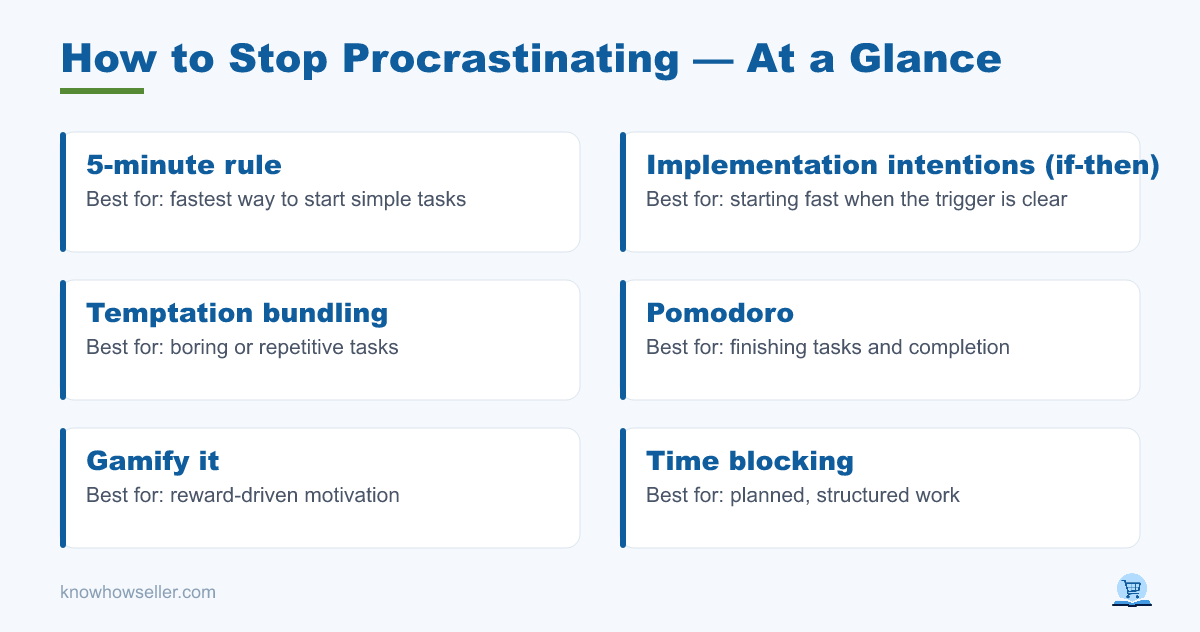
The most useful factor wasn’t willpower — it was reducing the delay between “I should” and “I’m doing it.” Methods that make the first action obvious and small tend to be best for getting started. Here is a practical comparison, lowest friction first.
| Method | Starting speed | Feels effortful? |
|---|---|---|
| 5-minute rule | Fastest for most simple starts | Very low |
| Implementation intentions (if-then) | Fast when the trigger is clear | Low |
| Temptation bundling | Fast for boring or repetitive tasks | Low |
| Pomodoro | Moderate; requires setting a timer | Medium |
| Gamify it | Moderate; depends on the reward system | Medium |
| Body doubling | Moderate; depends on another person or session | Medium (needs a partner or group) |
| Time blocking | Slower upfront; stronger for planned work | High (front-loaded planning) |
Which method wins on task completion? (Full ranking)
Starting fast matters, but finishing is the goal. In practical use, Pomodoro often performs well for completion because it pairs a defined start with a protected work interval. The 5-minute rule is excellent for breaking resistance, while implementation intentions help recurring work happen at the right time.
| Rank | Method | Completion support | Best for |
|---|---|---|---|
| 1 | Pomodoro (25/5) | Strong | Deep, dread-heavy tasks |
| 2 | 5-minute rule | Strong for getting unstuck | Getting started fast |
| 3 | Implementation intentions | Strong for repeated routines | Recurring, scheduled work |
| 4 | Temptation bundling | Useful for low-interest tasks | Boring but necessary chores |
| 5 | Body doubling | Useful when accountability helps | Isolation-driven avoidance |
| 6 | Gamify it | Useful when rewards stay meaningful | Repetitive habit-building |
| 7 | Time blocking | Best as a planning layer | Full-day planning, not single tasks |
*Directional practical comparison; not clinical results or statistically validated performance data.
Why Pomodoro won on finishing
Time-boxing can help because it turns vague effort into a defined work interval. Implementation intentions — “When situation X arises, I will do Y” — have substantial research support from psychologist Peter Gollwitzer and later meta-analytic work. Pomodoro borrows a similar logic: when the timer starts, the next action is already decided.
Why temptation bundling is underrated
Temptation bundling — only letting yourself enjoy something, such as a podcast or favorite drink, while doing the task you avoid — is associated with research by Katherine Milkman and colleagues, including a study on exercise follow-through. It is a gentle lever for boring work, though it may not be enough by itself for complex or emotionally loaded tasks.
What does the science say about beating procrastination?
The research consensus is that procrastination is often tied to self-regulation and emotion management, so solutions that reduce the emotional cost of starting can outperform pure willpower. In plain terms:
Procrastination is not just poor scheduling; it is often a short-term mood repair strategy that can undermine longer-term goals.
First-hand note from the comparison: the biggest shift was making the task feel smaller before trying to make motivation feel bigger. That’s the Belief × Thinking × Action formula in miniature: shrink the perceived threat, clarify the next move, and action becomes easier.
How do you actually start today?
Start by picking one dreaded task and applying the 5-minute rule right now: set a timer, do only the first tiny action, and give yourself permission to stop at five minutes. Many tasks become easier once the first action is already underway.
- Pick the task you’re avoiding most — avoidance is the signal, not the enemy.
- Shrink the start to one 5-minute action.
- Write an if-then plan: “When it’s 9 a.m., I open the doc and write one sentence.”
- Protect the block with a 25-minute Pomodoro once you’re moving.
- Log it so tomorrow’s start is easier than today’s.
If you want the logging and habit-loop handled for you, the VisionDream app turns big goals into daily habits and tracks the tiny starts that compound. And if you keep wondering why effort alone hasn’t worked, the book ‘Why Do I Fail While Others Succeed?’ unpacks the Belief × Thinking × Action formula behind the methods above.
The bottom line
You don’t need more self-blame — you need a smaller start and a structure that keeps you there. Use the 5-minute rule to begin and Pomodoro to finish. Everything else is a supporting lever. Procrastination shrinks the moment you stop waiting to feel ready and let a five-minute action carry you.