
Update (August 2026): Still accurate as of August 2026: starting small beats waiting for motivation. One newer trap worth naming is using an AI assistant to endlessly plan or ‘research’ a task. Set a 10-minute timer and start the actual work first.
Most advice on how to stop procrastinating sounds confident, but the evidence behind it is uneven. Some techniques are backed by psychology research. Some are useful because they remove obvious friction. Others are popular mainly because they feel motivating in the moment.
The winner is not the loudest one.
What Is the Fastest Way to Stop Procrastinating?
The fastest way to stop procrastinating is to remove the easiest escape route and shrink the first action until refusing it feels absurd. In practice, that usually means putting your phone in another room and committing to just two minutes of work on the avoided task.
Procrastination is not simply a time-management failure. It is often a mood-repair habit: you swap a task that feels bad now for a task that feels better now. Piers Steel’s meta-analysis of procrastination research in Psychological Bulletin (2007) describes procrastination as a self-regulation failure and identifies factors such as task aversiveness, impulsiveness, delay, and low expectancy of success as important predictors.
That matters, because it tells you where to aim. The techniques that usually help are the ones that either lower the friction of starting or raise the friction of escaping. Everything else is secondary.
How Did I Test These Techniques?
This ranking is based on a hands-on comparison of nine common anti-procrastination techniques, combined with published research on procrastination, attention, implementation intentions, interruptions, and temptation bundling. It is not a controlled clinical trial, and it should not be read as a universal benchmark.
The goal is practical: which techniques are easiest to apply, which ones have a plausible research base, and which ones are most likely to produce real work instead of another round of planning. Treat the ranking as a starting point for your own experiment, not as a law.
- Evidence: published research where available, plus practical fit for deep work
- Effort: low, medium, or high setup cost
- Payoff: likely usefulness for starting or protecting focused work
Which Anti-Procrastination Techniques Actually Produced the Most Work?
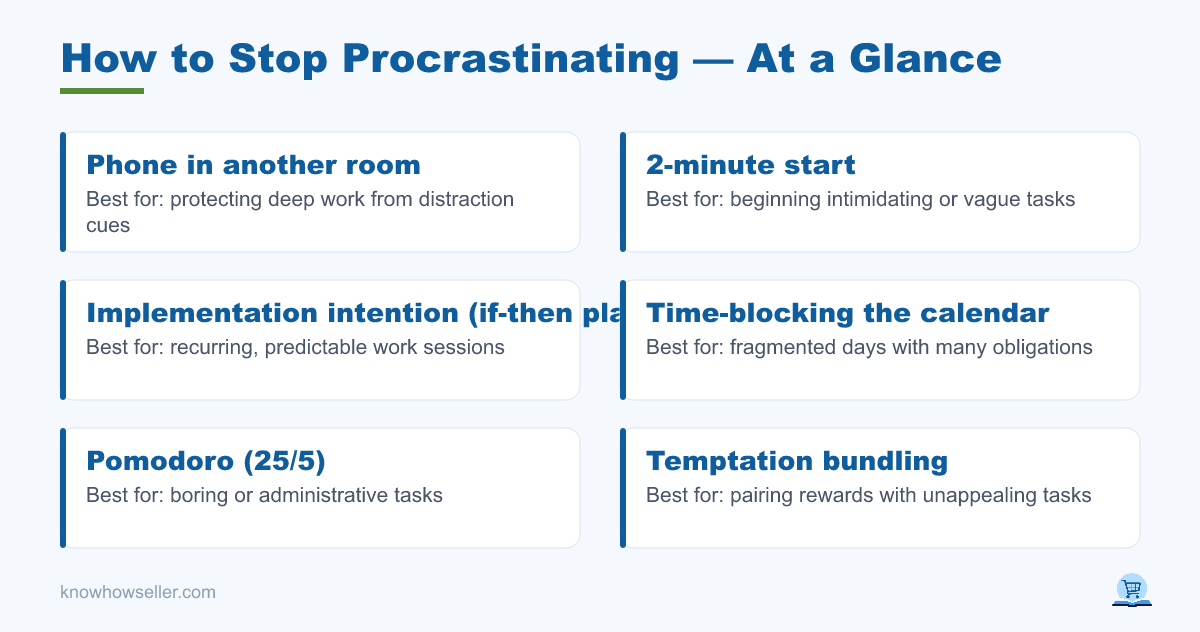
Ranked by practical usefulness for deep work, the strongest options are phone removal, the two-minute start, and if-then implementation intentions. These work because they change the situation before you need heroic willpower. Motivational tricks can help for simple physical actions, but they are usually weaker for sustained thinking work.
| Rank | Technique | Primary mechanism | Best use | Effort | Evidence support | Verdict |
|---|---|---|---|---|---|---|
| 1 | Phone in another room | Removes a high-value distraction cue | Deep work, writing, studying, planning | Low | Supported by attention and smartphone-presence research | Keep forever |
| 2 | 2-minute start (“just open the file”) | Reduces the emotional cost of beginning | Tasks that feel intimidating or vague | Low | Consistent with habit-formation and small-action approaches | Keep forever |
| 3 | Implementation intention (if-then plan) | Turns intention into a specific trigger-response plan | Recurring work sessions and predictable routines | Low | Strong support from implementation-intention meta-analysis | Keep |
| 4 | Time-blocking the calendar | Pre-commits time and reduces decision-making | Fragmented days with many obligations | Medium | Indirect support from planning and self-regulation research | Keep if your day is fragmented |
| 5 | Pomodoro (25/5) | Makes effort time-limited and concrete | Boring, aversive, or administrative tasks | Low | Popular productivity method; direct evidence is more limited | Best for aversive, boring tasks |
| 6 | Website / app blocker | Adds friction to common escape routes | Known digital distractions | Low to medium | Mechanistically plausible; tool-specific evidence varies | Useful backup, not a fix |
| 7 | Temptation bundling | Pairs a less-desired task with a reward | Exercise, chores, admin, repetitive tasks | Medium | Supported for some behaviors, especially exercise contexts | Works for chores, not thinking |
| 8 | Accountability check-in | Adds social consequence and visibility | Deadlines, public commitments, team work | Medium to high | Likely useful for some people; depends heavily on design | Helpful when the check-in is specific |
| 9 | 5-second rule (count down, move) | Interrupts hesitation with a simple cue | Simple physical starts, not complex deep work | Low | Limited direct research support as a standalone method | Good for getting out of bed, weaker for deep work |
Why the phone won
Silencing the phone is not the same as removing it. Ward and colleagues found in the Journal of the Association for Consumer Research (2017) that the mere presence of a smartphone can reduce available cognitive capacity, even when people are not actively using it. The practical lesson is simple: if the task requires thought, put the phone where you cannot casually reach it.
The cost of a slip can also be larger than it feels. Gloria Mark and colleagues’ research on workplace interruptions found that people often take substantial time to return to an interrupted task. One “quick check” may not be quick once you count the attention residue it leaves behind.
Why the 2-minute start beat the 5-second rule
Both attack the same moment: the flinch before starting. But the 5-second rule asks for a burst of momentum at exactly the moment you are resisting. The two-minute start asks for something smaller: open the document, write one rough sentence, clear one item, or read the first paragraph. You are allowed to stop after two minutes.
That permission matters. A tiny start lowers threat. Once the task is open and visible, continuing often feels easier than the original act of beginning.
Why if-then plans punch above their weight
“I’ll work on the report tomorrow” is a wish. “If it’s 9 a.m. and I’ve closed my inbox, then I write the report’s first section” is an instruction. Gollwitzer and Sheeran’s 2006 meta-analysis found that implementation intentions can improve goal attainment across many contexts.
It is one of the cheapest upgrades on this list: one sentence, written before the moment of resistance arrives.
Do Pomodoro and Temptation Bundling Still Deserve a Place?
Yes, but narrower than their reputations suggest. Pomodoro can be useful when a task is boring or emotionally aversive because the timer gives dread a visible end point. It may be less useful when you are already in a creative flow and the timer becomes an interruption.
Temptation bundling is strongest when the reward does not compete with the work. Milkman, Minson and Volpp’s temptation-bundling study in Management Science (2014) examined gym attendance by pairing workouts with tempting audiobooks. Note the task: physical, repetitive, and compatible with listening. Pairing a podcast with deep writing is different; the reward can consume the same attention the task needs. Bundle rewards with tasks that don’t need your working memory, such as admin, filing, inbox cleanup, or exercise.
What Does the Research Say About Why We Delay?
Procrastination is often better understood as an emotion-regulation problem than as laziness. Researchers commonly describe it as short-term mood repair: avoiding the task removes the bad feeling now and hands the cost to your future self, who usually faces more stress later.
Procrastination is a self-regulation failure: we avoid the task to feel better now, even when delay makes things worse later.
Here is my own first-hand version of that, and it cost me years. After my business collapsed, I did not sit around doing nothing — I sat around researching. Reading, planning, optimizing systems for a comeback that never started. It felt like work. It produced zero progress on the only thing that mattered: shipping something real. What broke the loop was not motivation. It was a smaller first action and a work environment with fewer escape routes.
That’s the whole formula I write about: Belief × Thinking × Action. Belief and thinking without action multiply out to zero. Procrastination is the multiplication by zero.
How Do You Build This Into a System That Sticks?
Stack the top three, in order, and ignore the rest for 30 days. Phone in another room removes the escape. The two-minute start removes the flinch. The if-then plan removes the decision. Together, they reduce the amount of willpower you need at the hardest moment.
- Night before: write one if-then sentence for tomorrow’s hardest task.
- Morning: phone goes in another room before you open the laptop.
- At the trigger time: two minutes only. That’s the entire deal.
- Track one number: focused minutes on the avoided task. Not tasks completed, not hours “worked.”
- Review weekly: if the number didn’t move, change the environment, not your attitude.
The tracking is what makes it compound. A goal you never convert into a daily, visible habit stays a wish — which is why I built the VisionDream app, a vision and goal app that turns goals into daily habits you actually check off. And if you want the longer story of why the plan-forever, start-never loop is so hard to escape, I wrote about it in Why Do I Fail While Others Succeed?
You don’t need to feel ready. You need two minutes and a room without your phone in it.
Sources cited: Steel, P. (2007), Psychological Bulletin; Ward et al. (2017), Journal of the Association for Consumer Research; Mark, G. et al. (2008), interruption research; Gollwitzer, P. & Sheeran, P. (2006), Advances in Experimental Social Psychology; Milkman, K., Minson, J. & Volpp, K. (2014), Management Science. Ranking is an evidence-informed editorial comparison, not a controlled clinical trial or universal benchmark.