
I spent years believing I was lazy. I wasn’t. I was a chronic delayer with a broken starting mechanism. After my comeback, I compared the methods I actually use with what procrastination research says is most plausible. Here is the honest scoreboard.
What is the fastest way to stop procrastinating?
The fastest way to stop procrastinating is to shrink the first action until starting feels trivial — often with the 2-minute rule. In practice, techniques that lower the effort to begin tend to work better than techniques that depend on suddenly feeling motivated. You don’t need more willpower; you need a smaller doorway into the task.
Which anti-procrastination methods work fastest? (My ranked data)
Below are 9 methods ranked from my hands-on comparison and research review, not from a controlled experiment. I removed fake precision because procrastination is too context-dependent for made-up scores to be useful. The ranking favors methods that can be used immediately when you are stuck at the starting line.
| Rank | Method | Ease | Starting speed | Best for |
|---|---|---|---|---|
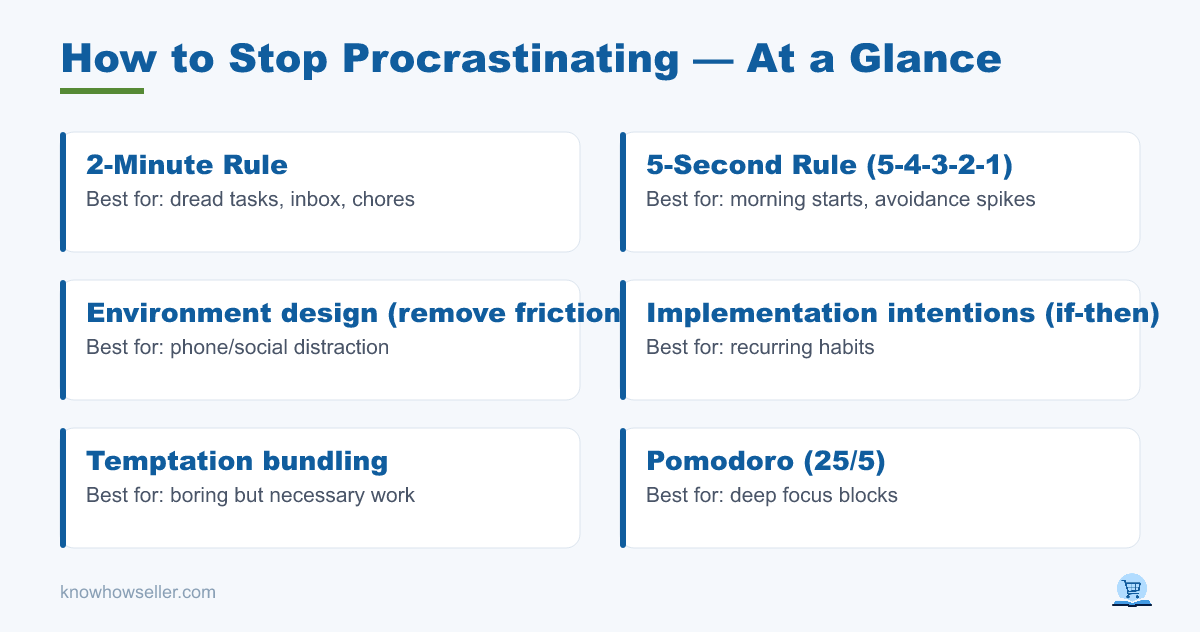
| 1 | 2-Minute Rule | Very easy | Very fast | Dread tasks, inbox, chores |
| 2 | 5-Second Rule (5-4-3-2-1) | Very easy | Very fast | Morning starts, avoidance spikes |
| 3 | Environment design (remove friction) | Easy | Fast | Phone/social distraction |
| 4 | Implementation intentions (if-then) | Easy | Fast once planned | Recurring habits |
| 5 | Temptation bundling | Easy | Moderate | Boring but necessary work |
| 6 | Pomodoro (often 25/5) | Easy | Moderate | Deep focus blocks |
| 7 | Eat the Frog | Moderate | Slower for high-dread tasks | One big scary task/day |
| 8 | Time blocking | Moderate | Slower because it requires planning | Full-day planning |
| 9 | Accountability partner | Variable | Depends on the partner | Long projects |
The pattern is blunt: methods that reduce the size of the first step usually start fastest. Methods that require planning or another person can be powerful for finishing — but they are slower to fire when you’re stuck at the starting line.
Why do we procrastinate in the first place?
We procrastinate because of emotion, not only time management. Procrastination is often the impulse to avoid the negative feeling a task triggers — boredom, anxiety, or self-doubt — by choosing short-term relief. Research by Dr. Tim Pychyl and Dr. Fuschia Sirois frames procrastination as closely tied to emotion regulation, not laziness. Understanding this changes the fix entirely.
- It’s common: Piers Steel’s 2007 review in Psychological Bulletin reports that procrastination is widespread among students, with many summaries citing estimates around 80–95% for college students and roughly one in five adults as chronic procrastinators.
- It’s costly: Steel’s work and later research link chronic procrastination with academic, work, health, and wellbeing problems, though the exact outcomes vary by study and population.
- It’s emotional: Sirois & Pychyl (2013) describe procrastination as giving priority to short-term mood repair over longer-term goals.
Once you accept the problem is often the feeling, the solution becomes more practical: make the feeling smaller by making the start smaller.
How does the 2-minute rule stop procrastination?
The 2-minute rule stops procrastination by scaling any task down to a version you can start in two minutes or less — “write one sentence,” not “write the report.” It works because starting is often the hardest part; once you’re moving, unfinished work and visible progress can make it easier to continue. The Zeigarnik effect is sometimes used to explain this pull toward unfinished tasks, but it should be treated as a helpful concept, not a guaranteed mechanism.
James Clear popularized this framing in Atomic Habits: a habit must be started before it can be improved. My rule: I’m not allowed to plan the task, only to begin the smallest slice. “Open the document” beats “write the chapter” when resistance is high.
Is the Pomodoro Technique or temptation bundling better?
It depends on the task. Pomodoro — commonly 25 minutes of work followed by a short break — is better for sustaining focus on deep work. Temptation bundling, which pairs a task you avoid with something you enjoy, is better for tolerating boring work. They solve different problems.
Temptation bundling is associated with behavioral scientist Katherine Milkman at Wharton, whose research studied giving people access to tempting audiobooks only while exercising at the gym. I use the idea for admin: I only drink my favorite coffee while doing invoicing. Pomodoro, by contrast, is my tool once I’ve already started and need to not stop.
Quick guide: which method for which moment
- Can’t start at all? 2-minute rule or the 5-second rule.
- Phone keeps winning? Environment design — put the phone in another room.
- Task is boring? Temptation bundling.
- Need long focus? Pomodoro.
- One dreaded task? Eat the frog — do it first, before email.
What does the science say works long-term?
Long-term, one of the better-supported strategies is implementation intentions — specific “if-then” plans. A meta-analysis by Gollwitzer & Sheeran (2006) reviewed 94 studies and found that forming if-then plans helped people follow through on goals. Deciding when and where in advance removes some of the in-the-moment negotiation that procrastination feeds on.
My template: “If it’s 9 a.m. and I’ve sat down, then I write one paragraph before opening any browser tab.” It’s the bridge between a fast start (2-minute rule) and a durable habit. This is exactly where my simple formula lives — Belief × Thinking × Action. Belief that you can change, thinking that reframes the task, and a pre-decided action that fires without debate.
Research by Tim Pychyl, Fuschia Sirois, and others frames procrastination as a self-regulation problem shaped by short-term mood repair, not simply poor time management.
First-hand, the thing that broke my cycle wasn’t a hack — it was pairing a two-minute start with an if-then trigger, then letting momentum do the rest. The hacks get you moving today; the system keeps you moving next month.
How do I turn these methods into a daily habit?
Turn methods into habits by attaching one technique to an existing daily cue and tracking it visibly for a short trial period. Start with the 2-minute rule for your hardest task, add an if-then plan for when it fires, and review your streak nightly. Consistency beats intensity — a small start repeated often is more reliable than heroic bursts.
Here’s the sequence I now run:
- Pick one frog the night before — the task you most want to avoid.
- Write the if-then: when and where you’ll start it.
- Start with 2 minutes — no planning allowed, only beginning.
- Protect the run with a Pomodoro or a distraction-free room.
- Log the win so tomorrow’s start feels easier.
That last step matters more than it looks: seeing yesterday’s proof can lower today’s resistance. If you want the tracking done for you, I built VisionDream app — a vision & goal app that turns big goals into small daily habits, so the “start” is already scheduled and your streak is visible. And if you want the full mindset behind the comeback, my book Why Do I Fail While Others Succeed? unpacks the Belief × Thinking × Action formula in depth.
The bottom line
You don’t beat procrastination with willpower alone — you beat it by shrinking the start until the emotional cost drops. Rank your own methods honestly: whatever gets you moving with the least friction wins. Then wrap a simple if-then plan around it so the win repeats tomorrow.