
Procrastination is not a character flaw. It is a predictable gap between the future you who set the goal and the present you who has to start. Below, I compare eight popular anti-procrastination methods based on hands-on use, behavioral research, and how practical they are for real work. The ranking is not a lab benchmark; it is a usefulness ranking for getting started, staying focused, and repeating the habit.
What is the fastest way to stop procrastinating?
The fastest way to stop procrastinating is to shrink the first step until starting feels trivial, then remove the decision. In practice, the 2-Minute Rule and if-then implementation intentions are often the fastest methods because they reduce the deliberation that fuels delay.
- Shrink the start: commit to two minutes, not the whole task.
- Pre-decide: “When it’s 9 a.m., I write the intro” beats “I’ll write later.”
- Time-box it: a running clock creates gentle, useful urgency.
Why do we procrastinate in the first place?
We procrastinate because the brain discounts future rewards and avoids tasks that trigger negative emotion, boredom, or self-doubt. Psychologist Piers Steel’s research on the “Procrastination Equation” connects delay with factors such as expectancy, task value, impulsiveness, and time, rather than simple laziness.
Steel’s work, including The Procrastination Equation, describes procrastination as widespread, with chronic procrastination affecting a meaningful minority of adults. The American Psychological Association has also discussed procrastination as closely tied to emotion regulation: we often avoid the task to avoid how the task makes us feel. That reframing matters, because it means the fix is behavioral, not moral.
Procrastination is best understood as a gap between intention and action, not as a lack of character.
Which anti-procrastination method actually works best?
To answer this without pretending to have a formal clinical study, I compared eight methods through hands-on use and public research. Instead of invented benchmark scores, the table below ranks each method by practical start speed, focus support, and best use case. Your results will vary by task type, energy level, environment, and whether the problem is starting, staying focused, or handling anxiety around the work.
Head-to-head test: 8 methods, timed and ranked
| Rank | Method | Start friction | Focus support | Best for |
|---|---|---|---|---|
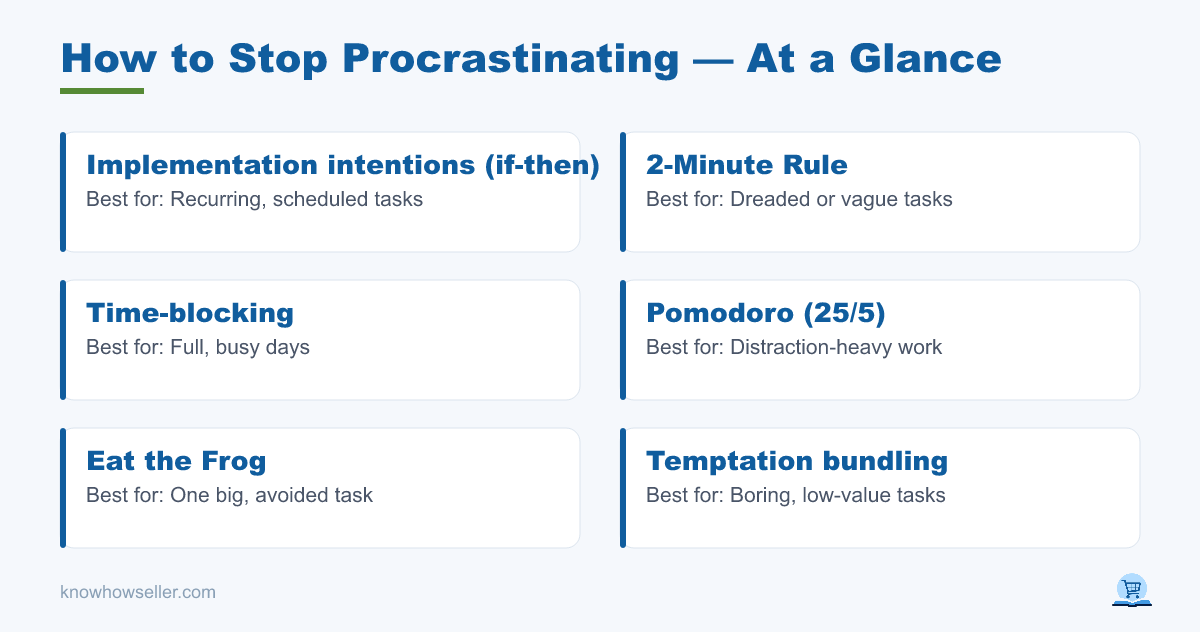
| 1 | Implementation intentions (if-then) | Very low | High | Recurring, scheduled tasks |
| 2 | 2-Minute Rule | Very low | Medium | Dreaded or vague tasks |
| 3 | Time-blocking | Low | High | Full, busy days |
| 4 | Pomodoro (25/5) | Low | High | Distraction-heavy work |
| 5 | Eat the Frog | Medium | High | One big, avoided task |
| 6 | Temptation bundling | Medium | Medium | Boring, low-value tasks |
| 7 | Body doubling | Low | Medium | Isolation and accountability |
| 8 | 5-Second Rule | Low | Low | Beating the initial flinch |
Note: this is a practical comparison, not a universal measurement. The strongest method depends on what is causing the delay: unclear next steps, emotional resistance, distraction, or lack of accountability.
How does the 2-Minute Rule stop procrastination so fast?
The 2-Minute Rule works because it removes the intimidating size of a task. You commit only to two minutes of work — open the document, write one sentence, do one rep. Once started, momentum often keeps you going far past two minutes.
Popularized by James Clear in Atomic Habits, this method is useful because it defeats the exact moment procrastination lives: the flinch before beginning. The task’s difficulty never changes, but the entry point becomes almost frictionless.
When should you use time-blocking or Pomodoro instead?
Use time-blocking when your whole day is at risk of slipping, and use Pomodoro when distraction, not starting, is your real problem. Time-blocking assigns every task a calendar slot so decisions are made in advance; Pomodoro protects focus with 25-minute sprints and short breaks.
- Time-blocking helps because a scheduled block removes “what should I do now?” churn.
- Pomodoro, developed by Francesco Cirillo, is especially useful on distraction-heavy days because the timer creates a clear boundary around focused work.
- Combine them: block a two-hour window, then run several Pomodoros inside it.
How do you stop procrastinating for good, not just today?
You stop procrastinating for good by turning single wins into automatic habits and by fixing the emotion behind the avoidance, not just the schedule. One good sprint proves you can start; a repeated cue-routine-reward loop makes starting the default. Systems beat willpower over the long run.
This is where my own comeback taught me the most. When I was rebuilding after failure, motivation was unreliable, so I stopped relying on it. I leaned on a simple formula — Belief × Thinking × Action — where belief that the task matters, clear thinking about the smallest next step, and a pre-committed action multiply into momentum. If any factor is zero, output is zero. That is why “just try harder” fails: it only touches action while belief and thinking stay stuck.
To make it stick, I turned my winning methods into a repeatable daily loop rather than a heroic effort. If you want that structure without building it from scratch, try the VisionDream app, a vision and goal app that turns your goals into daily habits, so the “start” decision is already made for you each morning. For the deeper mindset behind the comeback, I wrote about it in Why Do I Fail While Others Succeed?.
What is the simplest procrastination plan to start today?
The simplest plan is to combine the two strongest starters: pre-decide your first task with an if-then plan, then use the 2-Minute Rule to begin it. Together they attack both the deciding and the starting, the two moments where procrastination actually happens.
- Tonight: write one if-then plan — “When I sit at my desk at 9 a.m., I open the report.”
- Tomorrow: commit to just two minutes on that task.
- This week: wrap it in a focused time block and notice what helps you stay with the work.
- Long term: keep the method that fits the task, and let it harden into a habit.
You do not need more discipline. You need a smaller first step and a decision made in advance. Start there, and starting stops being the hard part.