
Written by Knowhow Seller, who writes about goals, habits, and motivation from a hard-won comeback using one simple formula: Belief × Thinking × Action.
How do you stop procrastinating on studying?
Stop procrastinating on studying by shrinking the first step until starting feels trivial: open the book and study for just two minutes. Procrastination is often understood as an emotion-regulation problem, not simply a laziness problem, so you beat it by lowering the entry cost, removing friction, and letting small wins build momentum that carries you into real work.
Most advice tells you to “be more disciplined.” That is the wrong diagnosis. Researcher Dr. Piers Steel, whose meta-analysis in Psychological Bulletin (2007) reviewed a large body of procrastination research, is often cited in connection with estimates that procrastination is widespread among college students. You are not broken. You are normal — and normal is fixable with the right system.
Why do students procrastinate on studying?
Students procrastinate because studying can trigger uncomfortable feelings — boredom, anxiety, or fear of failing — and the brain seeks quick relief by switching to easier tasks. Psychologist Dr. Tim Pychyl has described procrastination as “giving in to feel good.” It is short-term mood repair, not a character flaw, which is exactly why willpower alone rarely fixes it.
- The task feels vague. “Study biology” has no starting point; “read pages 40–45” does.
- The reward is far away. Exams are weeks off, but your phone rewards you in seconds.
- The gap feels huge. When a task looks overwhelming, avoidance feels safer than starting.
Chronic procrastination is common: psychologist Dr. Joseph Ferrari‘s research is often associated with the estimate that roughly 20% of adults may be chronic procrastinators. So this is a lifelong skill worth building now.
What is the fastest way to start studying when you don’t feel like it?
The fastest way to start is the two-minute rule: commit to studying for only two minutes, with zero pressure to continue. Starting is usually the hardest part, and once you are in motion, the same task that felt heavy often feels more manageable. Two honest minutes will not magically solve everything, but they can turn a frozen task into a task already in progress.
Pair the two-minute start with these frictions removed:
- Phone in another room — not face-down on the desk. Out of sight, out of mind.
- Materials pre-opened the night before, so tomorrow’s you has nothing to set up.
- One clear next action written on a sticky note: the single page, problem, or paragraph you start with.
Which study methods actually beat procrastination?
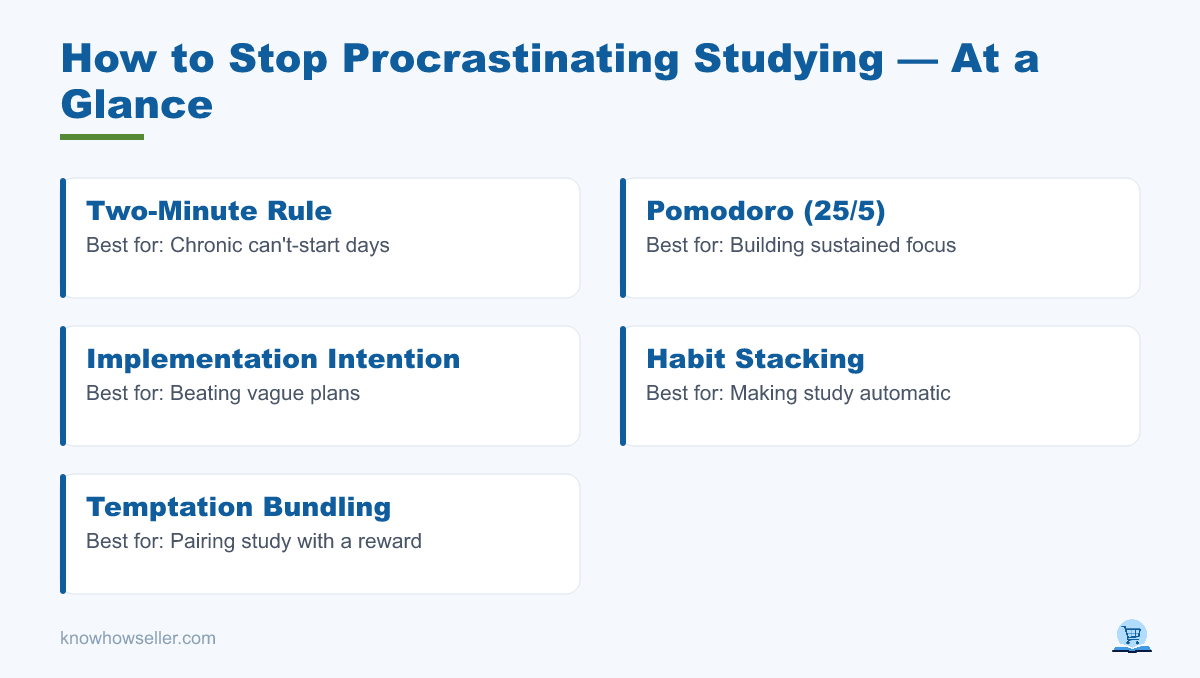
The best anti-procrastination methods work by making sessions short, structured, and finite so your brain sees a clear finish line. Timeboxing, implementation intentions, and habit stacking are more practical than vague “just focus harder” advice because they replace willpower with a repeatable trigger and a defined stopping point.
| Method | How it works | Best for | Effort to start |
|---|---|---|---|
| Two-Minute Rule | Commit to just 2 minutes to break inertia | Chronic “can’t start” days | Very low |
| Pomodoro (25/5) | 25 min focus, 5 min break, repeat | Building sustained focus | Low |
| Implementation Intention | “After lunch, I will study math at the library” | Beating vague plans | Low |
| Habit Stacking | Attach studying to an existing habit | Making study automatic | Medium |
| Temptation Bundling | Pair studying with a small reward | Boring subjects | Medium |
Implementation intentions have strong evidence behind them: a widely cited meta-analysis by Gollwitzer & Sheeran (Advances in Experimental Social Psychology, 2006) found that specifying when, where, and how you will act can improve follow-through across many studies.
Does your study environment really change how much you get done?
Yes — environment can be a major hidden lever. Distraction has a real cost: the American Psychological Association has reported that task-switching can reduce productive time by up to 40%. Instead of trying to out-discipline a distracting room, compare your environments honestly: where do you start fastest, get interrupted least, and finish the most work?
Environment comparison: what to track
You do not need a formal experiment to learn from your own study patterns. For a week, use the same subject, similar study blocks, and a simple log. Track focus time, work completed, and interruptions so you can see which environment actually helps you study.
| Environment | Focus quality to watch for | Work completed to track | Interruptions logged |
|---|---|---|---|
| Library (quiet floor) | Usually strongest when silence and social pressure help | Pages read, problems solved, or notes reviewed | Often low if phone and laptop tabs are controlled |
| Cafe (moderate noise) | Can help some students start, but conversations may pull focus | Best for lighter review or planning sessions | Often medium and variable |
| Dorm room | Convenient, but comfort cues can make avoidance easier | Works best when desk, bed, and phone are separated | Often higher if roommates, bed, or devices are nearby |
The takeaway is blunt: choose the place with the fewest interruptions, not the place that feels most comfortable. A library, empty classroom, or quiet corner may improve studying simply because it removes decisions and distractions. If your room is full of sleep cues, roommates, and “I’ll just check one thing” loops, changing rooms may be easier than trying to become tougher.
“I stopped trying to out-discipline my study environment and started changing the environment first. My grades did not improve because I got tougher — they improved because I stopped fighting distractions I could have removed.” — Knowhow Seller
How do you make studying a habit instead of a daily battle?
Make studying automatic by anchoring it to a fixed cue, keeping the first rep tiny, and tracking a visible streak. Habits form through repeated cue-routine-reward loops, so when studying always follows the same trigger — same time, same place, same opening action — you stop deciding whether to study and simply start.
Here is the loop I used to make it stick:
- Belief: “I am someone who studies daily” — identity first, not outcome first.
- Thinking: Plan the cue and the one next action the night before.
- Action: Show up, do the two-minute start, mark the streak.
That is the Belief × Thinking × Action formula in miniature. Miss all three and studying stays a battle; get all three aligned and it becomes a default. A single missed day is fine — the rule is simply never miss twice.
If turning goals into daily habits is the part you keep dropping, a tool can carry the tracking for you. I built my study streak around the VisionDream app, a vision & goal app that turns goals into daily habits so the cue and streak live outside your head. And if you want the deeper mindset behind the comeback, the book Why Do I Fail While Others Succeed? unpacks the belief-and-action loop in full.
What should you do on days motivation is completely gone?
On zero-motivation days, drop the goal to something almost embarrassingly small: read one page, solve one problem, or review one flashcard. The aim is not dramatic progress — it is protecting the streak and proving to yourself you still show up. Motivation often follows action more reliably than action follows motivation.
Stop waiting to “feel ready.” Feeling ready is what often happens after you start, not before. Lower the bar, take the two-minute start, and let momentum do the rest.