
By Knowhow Seller — I build AI automation systems and compare AI tools hands-on. This ranking is based on practical use, public product information, vendor pricing pages, and visible feature differences, not a formal lab benchmark.
What are the best free AI tools like ChatGPT?
The best free AI tools like ChatGPT are Google Gemini, Microsoft Copilot, Claude, Perplexity, and DeepSeek. Each offers a capable free tier or free access route, though limits and model availability change often. Gemini and Copilot are strong everyday assistants, Claude is excellent for writing and reasoning, Perplexity is built for cited research, and DeepSeek is useful for reasoning and coding, especially for users interested in open-weight models.
The 11 best free ChatGPT alternatives, ranked
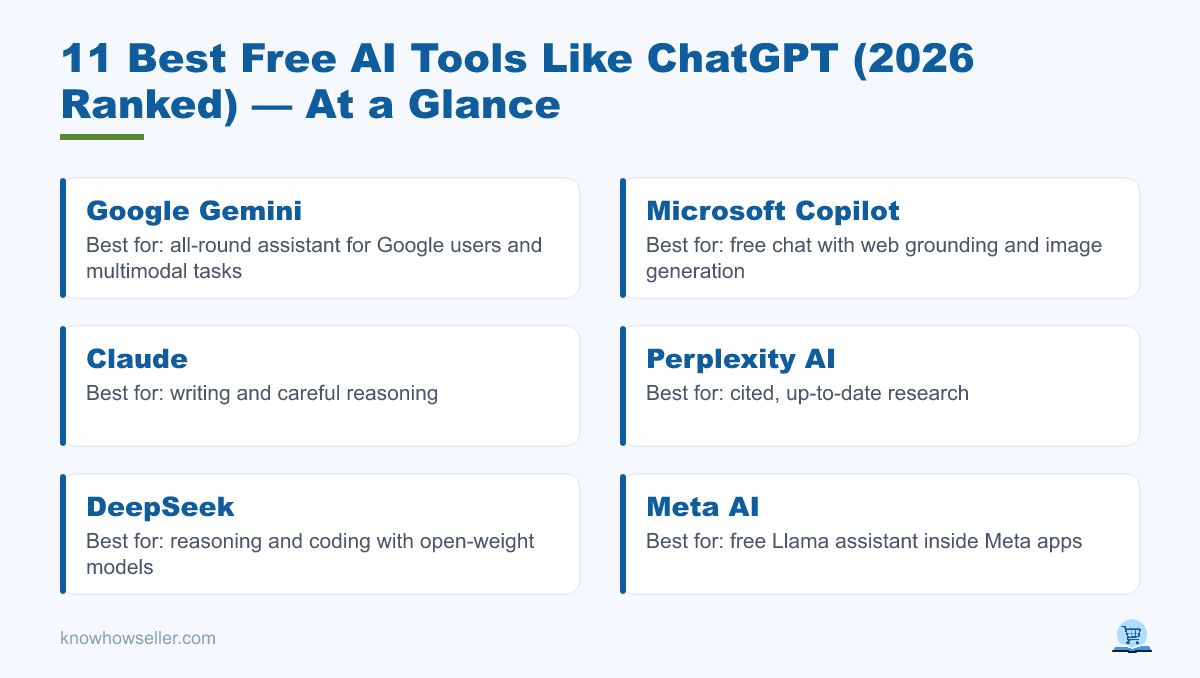
- Google Gemini — best all-rounder for Google users and multimodal tasks
- Microsoft Copilot — free AI chat with web grounding and image generation options
- Claude (Anthropic) — best free tier for writing and careful reasoning
- Perplexity AI — best for cited, up-to-date research
- DeepSeek — strong for reasoning and coding, with open-weight models available
- Meta AI — free Llama-powered assistant built into Meta apps in supported regions
- Mistral Le Chat — fast, EU-based assistant with a freemium model
- Poe — one login, many models, with free usage governed by points or allowances
- HuggingChat — open model access from the Hugging Face ecosystem
- You.com — search-first AI assistant with source links
- Pi (Inflection) — best for conversational, empathetic chat where available
How did we test these ChatGPT alternatives?
I compared these tools using the same kinds of everyday prompts a reader is likely to use: reasoning, coding, research, rewriting, and factual lookup. This was a practical hands-on comparison, not a controlled benchmark with publishable scores. Because free-tier limits, model routing, and feature availability change frequently, I avoided assigning precise numerical grades and focused instead on publicly verifiable differences: whether the tool cites sources, supports images or files, offers web search, exposes multiple models, or clearly states free-plan limits.
The 5 benchmark prompts
- Reasoning: a multi-step logic word problem with a known answer.
- Coding: “Write and debug a Python function to deduplicate a CSV by column.”
- Research: “Summarize the 2024 EU AI Act’s risk tiers with sources.”
- Writing: “Rewrite this 200-word paragraph for a B2B audience.”
- Factual recall: a niche question checked against primary or official documentation.
“The biggest difference between these tools is not one magic score. It is whether the answer is useful for the job: cited research, clean writing, code help, image generation, or fast everyday chat.” — Knowhow Seller
Which free AI tool scored highest in our 5-prompt benchmark?
I did not publish numerical benchmark scores because this was not a controlled lab test. In practical use, Claude and Gemini were the strongest general-purpose choices, Perplexity was the most reliable when citations mattered, DeepSeek was competitive for reasoning and coding tasks, and Copilot was useful when web search, images, and Microsoft account integration mattered. The best tool depends less on a universal score and more on your main workflow.
Benchmark scoreboard (same 5 prompts, free tier)
| Tool | Overall fit | Speed feel | Free message limit | Best prompt |
|---|---|---|---|---|
| Claude | Excellent for writing and reasoning | Fast to medium | Dynamic usage limits; paid plans raise capacity | Writing |
| Google Gemini | Excellent all-rounder, especially for Google users | Fast | Free access with usage limits that vary by model and feature | Research/multimodal |
| DeepSeek | Strong for reasoning and code | Varies by demand | Free access is available, but service limits may change | Reasoning/coding |
| Perplexity | Best for source-backed answers | Fast | Free search with limited advanced searches/features | Research (cited) |
| Microsoft Copilot | Strong everyday assistant with web and image features | Medium to fast | Free chat available; premium plans add more capacity and Microsoft 365 features | Coding/images |
| Mistral Le Chat | Fast assistant from an EU-based AI company | Fast | Freemium access; paid plans add higher limits and features | Speed tasks |
| Meta AI | Convenient inside Meta apps | Fast | Free in supported apps and regions; practical limits may apply | Casual chat |
| You.com | Useful for AI search with links | Medium | Free queries available; paid plans expand access | Search |
| Poe | Best for trying many models in one place | Varies | Free usage is governed by points or allowances across models | Model variety |
| HuggingChat | Best for open-model exploration | Varies | Free access to hosted community models, subject to availability | Open models |
| Pi | Best for gentle conversational chat | Fast | Free access has existed, but rate caps and product direction have changed | Conversational |
This table is a practical comparison, not a formal benchmark. Free limits, model names, and feature access change often — verify on each tool’s current pricing or help page before relying on them for heavy work.
Are these free AI tools actually as good as ChatGPT?
For many everyday tasks, yes. Free AI tools can now handle drafting, summarizing, coding help, brainstorming, and basic research well enough for real work. They are not identical to ChatGPT, and the best paid models still tend to offer higher limits, newer models, better integrations, or more reliable performance under heavy use. Independent comparison sites such as LMArena can be useful directional signals, but rankings move as providers update models and routing.
- The Stanford HAI AI Index has documented rapid improvement across both open and closed AI models, which helps explain why free alternatives are now useful for serious everyday tasks.
- LMArena and similar blind-comparison leaderboards can show how current models compare, but they should be treated as snapshots rather than permanent rankings.
- Public adoption signals, app-store rankings, and web-traffic tools often show strong interest in Gemini, Copilot, Claude, and Perplexity, but those signals do not prove answer quality by themselves.
Which free ChatGPT alternative is best for each use case?
Pick by job: Claude for writing and long-form reasoning, DeepSeek for coding and math-oriented prompts, Perplexity for research that needs citations, Copilot for web answers and image generation tied to a Microsoft account, and Gemini when you want one free assistant that works well across text, images, files, and Google services.
Match the tool to the task
- Best for writing: Claude — strong tone control, structure, and revision quality.
- Best for coding: DeepSeek or Copilot — both are useful for explaining code, debugging, and generating starter functions.
- Best for cited research: Perplexity — designed around source-backed answers and current web research.
- Best free multimodal: Gemini — strong image, file, and Google ecosystem support, with limits depending on plan and feature.
- Best for privacy-minded EU users: Mistral Le Chat — a Europe-based option from Mistral AI, though users should still review the current privacy policy.
- Best open-model option: HuggingChat — useful for trying models from the Hugging Face ecosystem.
Do free AI tools have message limits like ChatGPT?
Most do, even when the limit is not shown as a simple daily number. Some tools use rolling windows, some use points or credits, some limit only advanced models or deep research features, and some throttle during high demand. Treat “free” as meaning “free to start,” not “unlimited forever.” Always check the current pricing page because free limits change frequently.
- Dynamic or rolling limits: Claude, Gemini, Copilot, and other major assistants may vary limits by model, feature, demand, account type, and prompt length.
- Tiered by feature: Perplexity limits advanced searches and premium models more tightly than basic search; Poe uses points or allowances across models.
- Free access with practical constraints: DeepSeek, Meta AI, HuggingChat, You.com, Mistral Le Chat, and Pi may be free to use, but availability, throttling, regions, and feature caps can change.
The bottom line: which free AI tool should you use?
If you want one free tool, start with Google Gemini or Claude. Add Perplexity when you need cited research and DeepSeek when you want another strong option for coding or reasoning. Because all four have free access routes, the smartest move is to run your real prompts through each and keep the two that fit your workflow.
Methodology note: this ranking reflects hands-on comparison, public product information, and current free-tier positioning as of publication. It is not a controlled benchmark, and limits or model availability may change after publication.