

Most advice about keyword cannibalization is written for people cleaning up a mess after the fact: merge these two posts, redirect that one, rewrite the third. That advice arrives too late for anyone generating content with AI, because an automated pipeline can produce the duplicate faster than you can audit it. The fix belongs earlier — a rejection gate that runs before a single token is generated.
This is a working how-to from someone running a self-reinforcing content engine that publishes to WordPress on a schedule. I am not a developer and cannot read code; every part of this system was built by describing the problem to an AI and pasting errors back until they resolved. That matters here, because the dedup gate described below has to be simple enough for a non-coder to reason about when it misfires.
What is keyword cannibalization in AI-generated content?
Keyword cannibalization happens when two or more of your pages target the same search intent, so Google has to pick one and often splits ranking signals between them. With AI generation it compounds fast: a single seed keyword list can spawn near-identical drafts before anyone notices the overlap. The duplicate is not plagiarism — it is redundancy.
Google’s own documentation is blunt about the outcome. When Search encounters pages it considers duplicates or near-duplicates, it groups them into a cluster and selects one canonical URL to show; the others are generally not served (Google Search Central, “Duplicate content and canonicalization”). Google’s large-site crawl budget guide adds the second cost: duplicate and near-duplicate URLs consume crawl capacity that could have gone to pages you actually want indexed.
The scale context is worth keeping in view. Ahrefs’ analysis of roughly one billion pages found 96.55% received no organic search traffic from Google at all. Publishing a second article that competes with your own first one is a fast way to join that majority.
Why does an AI tools list produce the same article twice?
Because a seed keyword list is finite and a generator is not. An ai tools list of a few dozen keywords looks inexhaustible on day one, but keywords collapse into far fewer distinct intents. “Best AI writing tools,” “top AI writers,” and “AI writing software compared” are three list rows and one article. The generator cannot see that; it sees three unused rows.
Three failure modes drive it:
- Synonym collapse. Distinct strings, identical intent. String-level dedup passes them all.
- Angle drift. The model reframes an exhausted topic slightly — “for beginners,” “in 2026” — and produces the same body copy under a new headline.
- No memory of what shipped. If the pipeline never reads its own published archive before generating, every run starts from zero.
A seed list is a consumable resource. Treating it as permanent inventory is the root cause.
How do you run a cannibalization check before generation?
Run candidates through a layered gate: cheapest checks first, most expensive last. Normalize each candidate into an intent statement rather than a keyword, compare it against an index of everything already published, and reject on similarity before the generation call fires. Log every rejection with its reason — the log is the diagnostic instrument, not a byproduct.
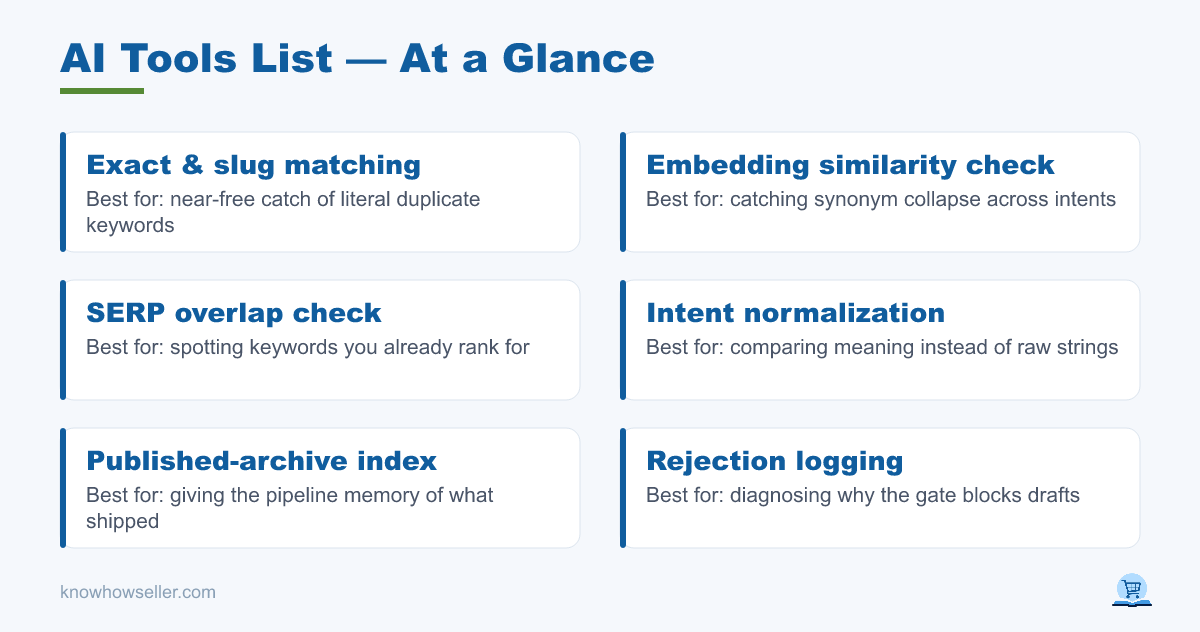
The ordering matters for cost. Exact and slug matching is nearly free and catches the laziest duplicates. Embedding similarity catches synonym collapse. A SERP check catches cases where you already rank and would be competing with yourself. Only survivors reach an LLM intent judgment, which is the expensive step.
Which dedup method should you use?
No single method covers all three failure modes, so layer them. The comparison below is based on how these methods work rather than on any scored benchmark: string matching is free but blind to synonyms, embeddings catch paraphrase but need a tuned threshold, SERP checks reflect reality but cost API calls, and LLM judgment is the most accurate and the most expensive per candidate.
| Method | Catches | Misses | Relative cost | Where to place it |
|---|---|---|---|---|
| Exact title / slug match | Literal repeats, re-queued rows | Every synonym and reframe | Negligible | Gate 1 |
| Keyword overlap (TF-IDF, n-gram) | Heavy vocabulary reuse | Same intent, different vocabulary | Very low | Gate 1 |
| Embedding cosine similarity | Synonym collapse, angle drift | Genuinely distinct posts that share jargon (false positives) | Low | Gate 2 — the workhorse |
| SERP overlap on your own domain | Cases where an existing post already ranks for the target query | Queries you have never ranked for | Medium (API calls) | Gate 3 |
| LLM intent judgment with logged reason | Subtle same-answer-different-framing overlap | Nothing much — but it is the slowest and priciest | High | Gate 4, survivors only |
One warning from experience: do not let a single vendor own the whole gate. My verification step ran on one LLM provider and died twice — once on auth, once on a usage quota. Publishing stopped entirely for weeks in the first case and for several days in the second, while every scheduled task still reported success. The fix was splitting verification across two different vendors and firing an alert even when the fallback succeeds, so a silent degradation still surfaces.
What does a full-slate rejection actually tell you?
It tells you the seed list is exhausted, not that the gate is broken. On one generation run, every candidate topic in the batch was rejected as cannibalizing existing posts. A completely empty slate is the clearest signal available that a niche’s keyword inventory has been fully consumed.
Here is what that run looked like in practice. Each candidate carried a rejection reason in the log. Reading them back, the pattern was obvious: several were synonym collapses against posts already live, and the rest were angle drift — the same underlying answer wearing a new headline. Not one was a false positive from an over-tight threshold, which is what I checked first.
The instinct in that moment is to loosen the threshold until something passes. That instinct is wrong. A gate you relax to get output is no longer a gate; you have simply chosen to publish the duplicate with extra steps. The correct response is to treat the empty slate as a stop condition and go refill the input.
What I did instead of loosening it:
- Widened the source of seeds beyond the original niche list — pulling question-shaped queries and long-tail variants rather than more head terms, since head terms were exactly what had collapsed.
- Mined the rejection log itself. Reasons that read “overlaps with post X” repeatedly pointed at posts strong enough to expand into genuinely separate sub-topics, which became new seeds that passed the gate cleanly.
- Accepted a lower publishing rate. The engine already throttles itself for a different reason (below), so a thin queue was not an emergency.
How does an index gate keep a thin queue from becoming a problem?
By making publishing volume conditional on indexed share rather than on schedule. My engine throttles itself when Google’s indexed share of mature posts falls below a threshold I set myself — currently a clear majority of them. That number is a configuration choice for my site, not a benchmark anyone should copy. The logic behind it is what transfers: if Search cannot keep up with what already shipped, adding more pages does nothing except widen the gap — and duplicates are the fastest way to widen it.
In practice the archive sits below full coverage, with a handful of URLs parked in “Discovered – currently not indexed” and a few stale entries still reported after deletion. Google’s Search Console documentation describes that first status as pages Google knows about but has not yet crawled, sometimes because crawling was deferred to avoid overloading the site. In other words, coverage lag is normal — and it is a reason to be selective, not prolific.
Pairing the two gates gives you a system that fails safely. The cannibalization gate blocks bad candidates going in; the index gate blocks volume going out. When the full slate of candidates was rejected, the index gate meant the pause cost nothing.
What should the pre-generation gate log for you to trust it?
Every rejection needs a machine-readable reason, the ID of the conflicting post, and the similarity score that triggered it. Without those three fields you cannot tell an exhausted seed list from a mis-tuned threshold — and those two situations demand opposite responses. The log is what converts a blocked run into a decision.
A related lesson about review loops: I once ran an AI second-opinion review on every single code edit and hit a churn loop, where the reviewer critiqued unfinished work and I kept reflexively rewriting it. Moving the review to once per session end fixed it. The same principle applies to the dedup gate — run it at a defined checkpoint before generation, not continuously against half-formed ideas.
The gate is cheap to build and it changes what your archive becomes: a set of posts that each answer something the others do not, rather than a pile competing for one canonical slot.