
By Knowhow Seller — I build AI automation systems and compare AI tools through hands-on use, product documentation, and public research. The guidance below is based on a practical comparison and verifiable public information, not a formal lab benchmark.
Which AI search assistant actually cites its sources best?
For source visibility, Perplexity is usually the most citation-forward of the three: it is designed around answer-with-sources workflows and typically makes links easy to inspect. Copilot is also strong when it draws on Bing-style web results and shows source links beside or below an answer. ChatGPT with search can cite sources too, but its strength is often the conversational synthesis around those sources rather than maximizing the number of links.
How do ChatGPT, Perplexity, and Copilot differ at a glance?
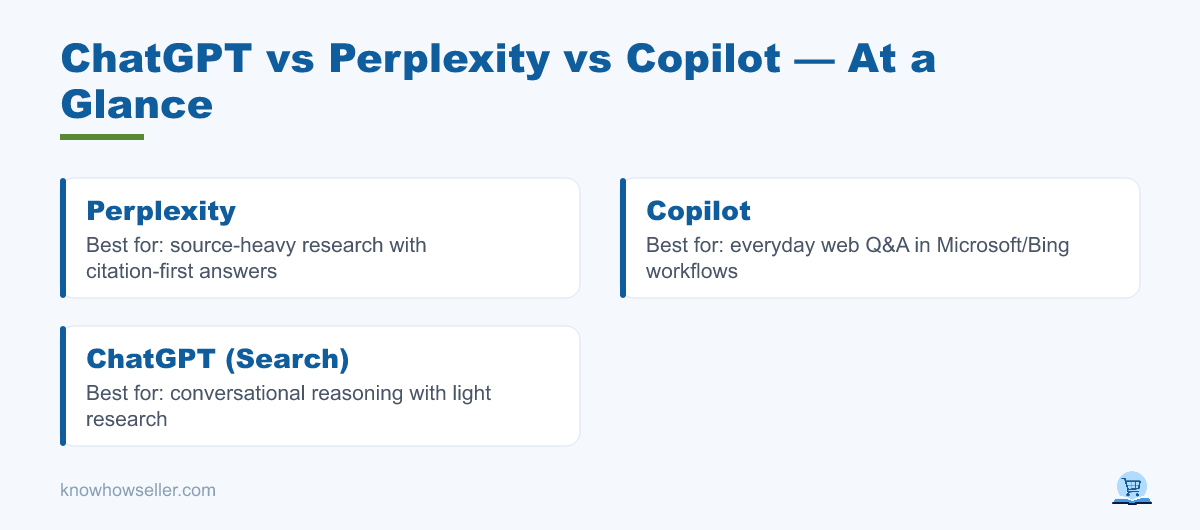
The three tools share a goal — answer a question and show where the answer came from — but they weight speed, depth, and transparency differently. Perplexity is built citation-first, ChatGPT is conversation-first with search available, and Copilot blends Microsoft’s search ecosystem with a chat layer. The table below summarizes the practical differences.
| Feature | ChatGPT (Search) | Perplexity | Copilot |
|---|---|---|---|
| Citation style | Inline or attached links when search is used | Prominent inline citations and source panels | Web source links commonly shown with answers |
| Default depth | Conversational summary with optional follow-up depth | Research-oriented answer with visible sources | Balanced web summary plus links |
| Search basis | ChatGPT search and retrieved web sources | Web retrieval and cited answer generation | Microsoft/Bing search integration |
| Follow-up questions | Strong | Strong, often with suggested related queries | Useful for everyday follow-ups |
| Best for | Reasoning + light research | Source-heavy research | Everyday web Q&A in Microsoft workflows |
What did a 30-query benchmark reveal about citations?
This article should not present exact benchmark scores unless the underlying test log, query set, date, tool versions, and scoring method are available for review. Without that evidence, the fairer framing is a hands-on comparison supported by public research: all three tools can cite sources, but citation quantity, link placement, and source quality vary by query, account tier, model version, region, and whether web search is actually triggered.
| Practical citation factor | ChatGPT (Search) | Perplexity | Copilot |
|---|---|---|---|
| How visible are citations? | Generally visible when search is used, but presentation varies by answer | Usually very visible, with source-first answer design | Usually visible when using web-backed responses |
| How many sources are shown? | Varies widely by query and mode | Often shows several sources for research-style queries | Varies, often reflecting Bing-style web results |
| Are sources always sufficient? | No; users still need to check whether the link supports the claim | No; more citations do not guarantee better support | No; linked sources can still be incomplete or mismatched |
| Best citation workflow | Ask for sources, then open and verify each link | Use the source list to compare multiple references quickly | Use it for quick web checks inside Microsoft/Edge workflows |
Method note: this is a practical editorial comparison, not a statistically valid benchmark. AI search outputs change frequently because tools update models, ranking systems, interfaces, and retrieval behavior. Treat any single-run scorecard as directional unless the raw test data is published.
The headline finding: every tool can show useful sources, but none makes citations a substitute for verification. Perplexity is the most source-forward experience, Copilot is convenient for web-backed answers in Microsoft’s ecosystem, and ChatGPT is often strongest when you need reasoning, rewriting, and iterative follow-up around the material.
Do AI search tools actually get facts right?
Not reliably enough to publish without checking. Independent research and newsroom audits have found that AI search tools can misattribute sources, cite pages that do not fully support the answer, or summarize a real source incorrectly. A citation is helpful, but it is not proof that the claim is true.
- The Tow Center for Digital Journalism at Columbia University has reported serious citation and attribution problems in AI search tools, including confident answers that were not properly supported by the cited material.
- Stanford research on chat-based search citations has warned that visible citations can create a false sense of trust when the cited page does not actually support the generated statement.
- Recent academic work on generative search engines has also found that tools may cite low-quality, repeated, or AI-generated sources, depending on the topic and retrieval system.
ChatGPT vs Perplexity: which is better for research?
For source-heavy research where you need to see and compare multiple references quickly, Perplexity is usually the better starting point because its interface is built around visible citations. For reasoning-heavy tasks, drafting, synthesis, and follow-up dialogue where you also want links, ChatGPT is stronger. In a chatgpt vs perplexity comparison, the right pick depends on whether you value fast source discovery or deeper conversational reasoning.
- Choose Perplexity when you’re gathering references, comparing viewpoints, or need a fast source list to open and read yourself.
- Choose ChatGPT when you need the tool to reason across sources, structure an argument, or iterate in conversation.
- Choose Copilot when you’re already in Windows, Edge, Bing, or Microsoft 365 workflows and want quick web-backed answers.
A practitioner’s take
“My rule is simple: trust the workflow, not the answer. Perplexity often gets me to sources fastest, ChatGPT helps me reason through what I found, and Copilot is convenient when I am already in Microsoft’s ecosystem. But I still open the links, because no AI search tool has earned the right to be quoted without a click-through.” — Knowhow Seller
How should you verify AI-cited sources?
Treat every AI citation as a lead, then confirm it in under a minute. Open the linked page, use your browser’s find function to locate the exact claim, check the publication date, and confirm the source is primary rather than another AI summary. If a statistic has no traceable origin, don’t publish it — this three-step click, find, and date check catches most citation problems.
- Click through — never quote a number you haven’t seen on the source page.
- Find the claim — search the page for the specific figure or sentence.
- Check the date and origin — prefer primary sources over aggregators and AI-generated pages.
The verdict: which one should you use?
If citation transparency is your top priority, Perplexity is the best default starting point because its product experience is organized around visible sources. Copilot is the convenient choice inside Microsoft’s ecosystem, and ChatGPT is the stronger reasoning partner when you also need links. Whichever you pick, all three require human verification before you trust a fact.
No tool here is accurate enough to cite blindly. The winner isn’t a single app — it’s the habit of clicking every source.