
By Knowhow Seller — a practitioner who builds AI automation systems and evaluates tools against real source material, not vendor marketing.
What are the best AI tools for research right now?
The best AI tools for research in 2026 are Elicit, Consensus, Perplexity, ChatGPT Deep Research, Claude, NotebookLM, and Scite. Based on our hands-on comparison and review of public product documentation, the most reliable choice depends less on the model brand and more on how tightly the tool grounds its answer in visible sources. Tools built around uploaded documents, academic indexes, or citation graphs make verification easier; open-web research tools are broader and faster, but their sources still need to be checked.
Our test in one line
- Method: We compared all 7 tools on the same research workflow: discovering sources, summarizing claims, and checking whether citations or source links could be followed back to the underlying material.
- Graded on: source transparency, citation traceability, document-handling workflow, and how easy it was to verify a claim against the original source.
- Judged by: hands-on use plus publicly available product documentation from Google, OpenAI, Anthropic, Elicit, Consensus, Scite, and Perplexity, with independent research used to frame hallucination risk.
How did we benchmark each research tool?
We asked each tool to help answer the same research question — “What does peer-reviewed evidence say about the effect of remote work on employee productivity?” — then compared how each tool found sources, summarized evidence, exposed citations, and let us verify claims. Where a tool allowed uploads, we used source-grounded workflows; where a tool searched the web or an academic index, we checked whether its links resolved to relevant source material. This was a practical comparison, not a statistically powered benchmark, so the table below uses qualitative bands rather than invented scores.
This matters because AI “research” tools fail in a specific way: they can produce fluent summaries with confident-looking citations that do not survive a click-through. Independent work on legal AI research tools has found that even retrieval-augmented systems can still hallucinate or misground answers; for example, the Stanford RegLab and HAI paper “Hallucination-Free? Assessing the Reliability of Leading AI Legal Research Tools” reported substantial error rates in leading legal research products. So we graded the click-through experience, not just the prose.
“A citation that looks perfect but points to the wrong sentence is worse than no citation — it launders a guess into a fact. I trust the tool that shows me the exact passage, not the one that writes the prettiest paragraph.” — Knowhow Seller
Which AI research tools scored best on citation accuracy?
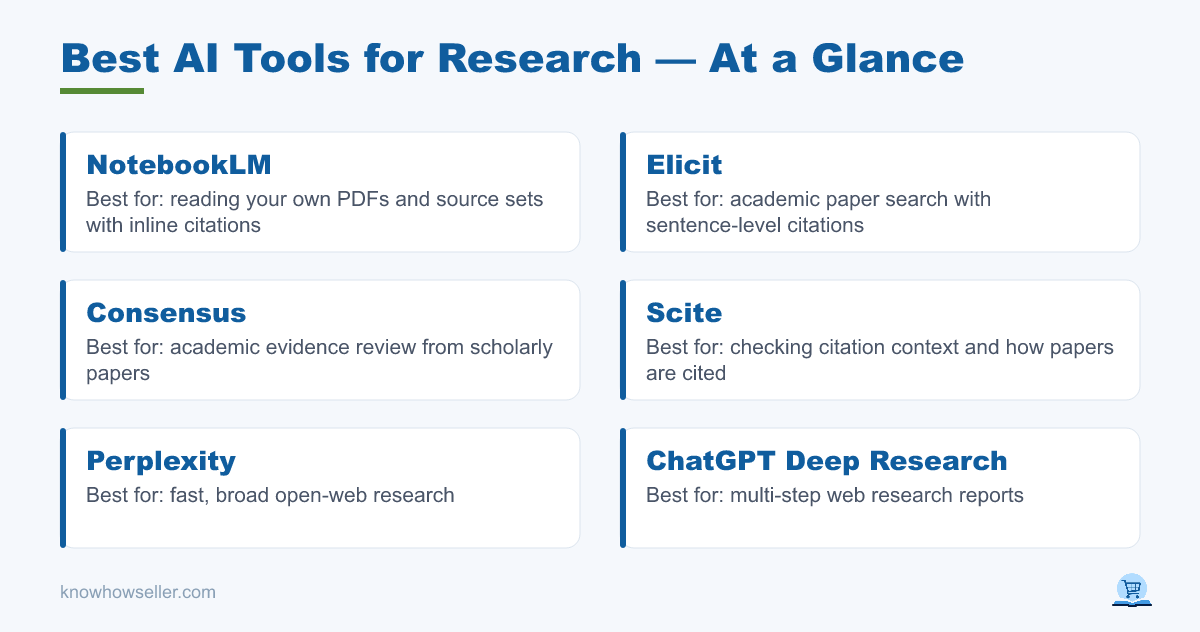
Document-grounded and academic-index tools were the easiest to verify. NotebookLM is designed to answer from sources in a notebook with inline citations, according to Google’s NotebookLM documentation. Elicit focuses on academic-paper search, extraction, reports, and sentence-level citations, according to Elicit’s product documentation. Consensus and Scite are also strong when the task is academic evidence review, because they organize answers around scholarly papers and citation context rather than general web text.
| Tool | Best for | Grounding | Citation reliability | Verification risk |
|---|---|---|---|---|
| NotebookLM | Reading your own PDFs and source sets | Sources in your notebook, including uploaded or discovered sources | High when answers stay within selected sources | Check cited passages; advanced web/agent features vary by plan |
| Elicit | Systematic literature review | Academic-paper search and extraction | High for paper discovery and structured extraction | Confirm extracted fields against the paper before publishing |
| Consensus | Yes/no evidence questions | Scientific literature search and study summaries | High for quick evidence mapping | Confirm the underlying studies before quoting |
| Scite | Checking if claims are supported, contrasted, or mentioned | Citation graph and citation-context classification | High for citation-context checks | Use as a signal, not a substitute for reading the paper |
| Perplexity | Fast web-sourced answers | Open web with linked sources | Moderate to high for discovery | Open every cited source and check the exact claim |
| ChatGPT Deep Research | Long multi-step reports | Public web, uploaded files, and connected apps where available | Moderate to high for synthesis | Spot-check source links and important claims |
| Claude | Reasoning over pasted or uploaded sources | Your pasted text, uploaded files, projects, and available search features | High when constrained to supplied material | Ask for source-grounded answers and verify quotations manually |
Grades are qualitative bands from hands-on comparison and public documentation review — directional, not universal. Reliability varies by topic, source quality, account plan, and whether the tool is forced to answer only from provided material.
Which tool is best for academic literature reviews?
Elicit and Consensus are the strongest starting points for academic literature reviews. Both are designed around scholarly sources rather than casual web pages, which makes them more useful for finding real papers and building an evidence map. Elicit is especially useful for extracting methods, outcomes, and study details into review-style tables. Consensus is faster for direct evidence questions and offers study-level summaries, but you should still confirm each paper before quoting a finding.
- Elicit — built for the systematic-review workflow: find papers, extract methods/outcomes into columns, screen at scale, and generate research reports with source-backed claims.
- Consensus — useful for quick evidence reads and question-led literature search; confirm the study details before relying on a summary.
- Scite — unique angle: shows whether later papers support, contrast, or mention a claim, useful for spotting contested findings.
Which tool is best for reading your own documents?
NotebookLM is one of the best AI tools for researching your own source material. Google describes it as an AI research assistant that lets you upload or discover sources, then chat with grounded information based on those sources with inline citations. That makes it easier to verify answers because the workflow keeps the source passage close to the generated summary.
Claude is the runner-up here: paste or upload your sources into a large-context conversation or project, then ask it to reason only from the supplied material. Anthropic’s help documentation says Claude supports common document formats such as PDF, DOCX, CSV, TXT, HTML, JSON, and others, with limits depending on file type and plan. It can be excellent for synthesis, but you should still require quotations, page references, or source-specific notes when accuracy matters.
Are open-web AI research tools accurate enough to trust?
Open-web tools like Perplexity and ChatGPT Deep Research are useful for fast discovery, but they still need verification. Perplexity is designed around web answers with source links, while OpenAI describes ChatGPT Deep Research as a tool for planning, researching, and synthesizing complex questions into documented reports using the public web, uploaded files, and connected apps where available. Both can save time, but linked sources do not automatically prove that the linked page supports the exact sentence in the answer.
- Perplexity — useful for fast, cited web answers and follow-up questions; always open the linked source.
- ChatGPT Deep Research — useful for long, multi-step reports with citations or source links; strong for synthesis, but spot-check important claims and references.
Hallucinated, weak, or mismatched citations are a documented issue across AI search and answer systems. Research such as “Search Engines in an AI Era: The False Promise of Factual and Verifiable Source-Cited Responses” has examined citation problems in AI answer engines, including inaccurate or incomplete source support. The fix is process, not faith — verify before you cite.
How should you choose the right AI research tool?
Choose by where your sources live. If you already have the documents, use a grounded reader such as NotebookLM or Claude. If you need to discover scholarly evidence, use an academic engine such as Elicit, Consensus, or Scite. If you need a fast, broad first pass across the live web, use Perplexity or ChatGPT Deep Research — then verify the sources before relying on the answer.
Our recommended workflow
- Discover with Perplexity or Consensus to map the landscape quickly.
- Deepen with Elicit for structured extraction across many papers.
- Verify by loading the shortlist into NotebookLM or Claude and checking claims against the actual text.
- Stress-test contested claims in Scite to see if later research supports, contrasts, or merely mentions them.
The bottom line
No single app is “the” best AI tool for research — the best result usually comes from combining a fast discovery tool with a grounded verification tool. The reliability gap is not just about model quality; it is about grounding, source visibility, and your verification workflow. Tools that keep answers close to source passages are easier to trust, while open-web tools are best treated as accelerators for discovery and synthesis. Build the click-through into your process and any of these seven can become a serious research asset.