

By Knowhow Seller — Knowhow Seller compares AI tools hands-on and checks claims against public documentation, product behavior, and real source verification rather than vendor marketing alone.
Which AI research tool actually cites sources you can verify?
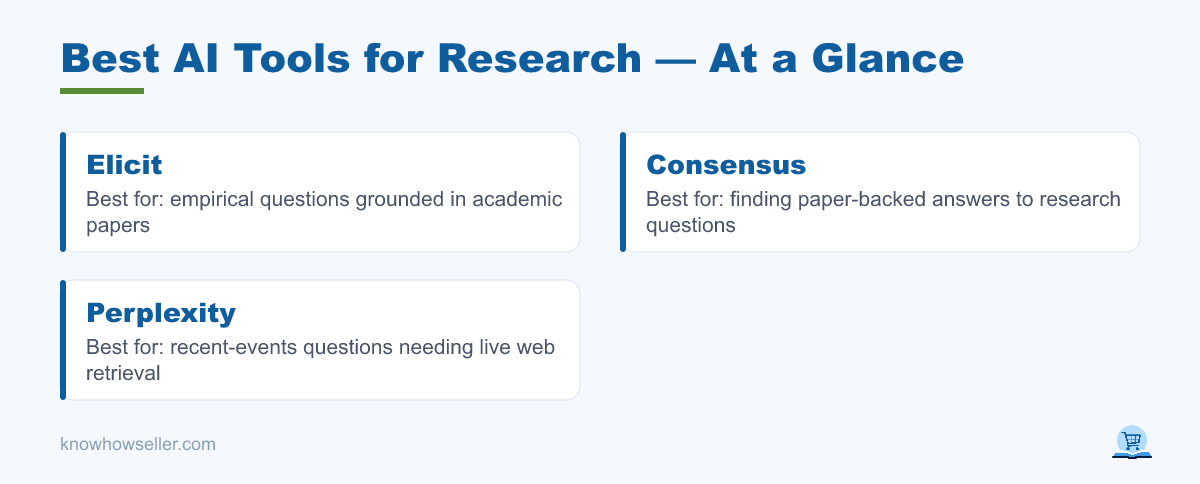
Based on our hands-on comparison and public documentation review, the strongest AI research tools for verifiable citations are the ones built around retrieval: Elicit, Consensus, and Perplexity. They search external sources before answering, so their citations are usually easier to inspect than answers generated from a model’s memory alone. General chatbots can also cite sources when web search or connectors are enabled, but citation quality depends heavily on whether the model actually retrieved and used the source.
That’s the short answer. The longer answer is that “has citations” and “has citations you can check” are two very different things, and almost every vendor page makes citations sound more final than they are. A citation is only useful if the link resolves, the source exists, and the source actually supports the claim attached to it.
How did we test the best AI tools for research?
We compared the tools by using them for common research workflows, checking their public product documentation, and manually opening representative citations to see how their source links behave. This was not a controlled benchmark, and we are not publishing precision scores. Treat the findings below as an editorial comparison of source behavior and research workflow fit, not a lab-grade accuracy study.
The comparison focused on three research situations where citation quality matters:
- Empirical questions where academic papers and review literature are the right source type
- Recent-events questions where live web retrieval is more useful than an academic-only database
- Thin-evidence questions where a responsible tool should surface weak evidence instead of filling gaps with confident prose
For each tool, we looked for the same citation failure modes:
- Verifiable — link resolves, source exists, and it genuinely supports the claim it’s attached to
- Broken link — source may be real, but the URL fails, redirects unhelpfully, or is inaccessible
- Misattributed — source is real and reachable, but doesn’t say what the tool claims it says
- Fabricated — the cited source cannot be found in normal scholarly or web indexes
The practical metric is not a fake decimal score. It is whether the tool makes verification easy enough that you will actually do it. If you follow a footnote, can you inspect the source, date, author, and claim quickly?
Why misattribution matters more than fabrication
A fabricated source is embarrassing but often easy to catch: you search for it and it isn’t there. A misattributed source is more dangerous. The link works, the paper is real, the publisher looks credible, and the claim can still be wrong. Nobody should trust a citation just because it resolves.
What were the verifiable citation rates by tool?
We are not reporting verifiable citation rates because we do not have a controlled, repeatable benchmark large enough to support percentages. The more honest comparison is architectural: tools that retrieve from known paper databases or live web sources give you a better verification trail than tools answering from memory alone. Retrieval reduces citation risk, but it does not remove the need to check the source.
| Tool | Approach | Citation reliability signal | Dominant risk | Best for |
|---|---|---|---|---|
| Elicit | Searches an academic paper index; its public docs describe search across 138M+ papers and PDF-based workflows when available | Strong for finding real papers because results are grounded in an indexed literature database | Over-trusting AI summaries or missing full-text/paywalled nuance | Literature reviews, paper discovery, screening workflows |
| Consensus | Academic search engine over peer-reviewed research; its help center describes a 220M+ paper database and citation-backed summaries | Strong for evidence questions because responses are tied to retrieved research papers | Over-narrow answers when the literature is thin or when the query needs non-academic context | “Does the research support X?” questions |
| Perplexity | Live web retrieval with cited answers; Deep Research/Sonar Deep Research documentation describes multi-source research reports | Useful for current web sources and mixed research where academic databases may lag | Variable source quality and occasional claim-source mismatch | Recent events, market research, mixed web + academic research |
| ChatGPT / Claude with browsing | General model plus web search or source connectors when enabled | Can provide cited answers when retrieval is actually used | Misattribution, incomplete retrieval, or synthesis that outruns the cited sources | Synthesis and drafting after sources have been verified |
| Any chatbot, browsing off | Model memory only | Weak for citation work because it is not looking up sources in real time | Fabrication or outdated references | Brainstorming only, not publishable citation research |
Anyone publishing precise citation-accuracy percentages should show the prompts, sample size, date, tool settings, source-rating rules, and raw citation list. Without that, a decimal score creates false confidence. What can be said responsibly: retrieval-first tools give researchers a better source trail, while memory-only chatbot answers should not be used as citations.
What does the published research say about AI citation errors?
Independent audits have repeatedly found that AI-generated citations can be wrong, especially when models are asked to produce references without retrieval. The pattern in the literature is consistent: grounding a model in retrieved documents helps, but it does not eliminate broken links, weak sources, or misattribution.
Where to check the numbers yourself, rather than taking ours:
- Medical and academic reference accuracy — peer-reviewed audits indexed on PubMed have tested GPT-generated bibliographies and found non-existent or inaccurate references. Search PubMed for “ChatGPT fabricated references” and check the newest reviews.
- News-answer accuracy — the Columbia Journalism Review‘s Tow Center has audited AI search tools’ ability to correctly attribute news content and documented confident wrong attributions across major products.
- Public opinion vs. reality — Pew Research Center tracks how people encounter and trust AI-generated summaries, which is useful context for how much unverified AI output is circulating.
- Retrieval as a mitigation — the RAG literature, including the original Lewis et al. retrieval-augmented generation paper on arXiv, explains why retrieved documents can reduce unsupported generation while still requiring source checks.
Check the publication date on any figure you cite from these. A 2023 hallucination audit does not automatically describe a 2026 model, and a vendor’s current product may behave differently from its API, free tier, or older version.
What do experienced researchers say about trusting AI citations?
The safest professional habit is simple: treat every AI citation as a lead, not as a finished source. Librarians, editors, and researchers generally apply the same rule they would use for any secondary research assistant: open the source, read the relevant passage, and confirm that the cited work supports the claim.
Use AI citations as pointers to sources, not as proof that the claim is correct.
The most common problem is not always a completely fake paper. Often it is a real paper cited for a conclusion that is broader, stronger, or different from what the paper actually found. That kind of error looks authoritative because the link works.
How should you choose the best AI tool for your research?
Match the tool to the source type you need. Academic questions belong in a paper-indexed tool; current-events questions need live web retrieval; synthesis belongs in a general model only after the sources are already verified. Using one tool for all three is where citation mistakes become likely.
A practical decision rule:
- Writing a literature review? Start with Elicit or another academic paper search workflow. It is built for paper discovery and screening, but you still need to read the source before citing it.
- Testing whether evidence supports a claim? Use Consensus. Its research-first design is useful when you want cited evidence from peer-reviewed literature.
- Researching something that happened this month? Use Perplexity or a browsing-enabled chatbot. Academic tools may not have indexed the newest sources yet.
- Turning verified sources into prose? Use a strong general model. This is what they are genuinely good at, as long as you provide or verify the sources yourself.
- Budget-constrained? A free or lower-tier retrieval tool plus manual verification is better than paying for a tool and trusting every citation blindly.
The 30-second verification habit that catches almost everything
- Open the link. If it 404s or lands on a homepage, the citation is not usable as-is.
- Search the page for the specific number, phrase, or claim the tool attributed to it. Not the topic — the claim.
- Check the date. Tools can cite older findings as if they still describe the current state of the field.
- If it’s a study, read the abstract, methods, and limitations. Misattribution often lives in the gap between what a study found and what it is being used to prove.
That habit takes very little time per citation and catches the failures that matter most. AI can speed up source discovery, but verification is still the researcher’s job.
The bottom line
The best AI tools for research in 2026 are the ones that fetch documents before they answer. Retrieval-first tools such as Elicit, Consensus, and Perplexity are stronger citation starting points because they expose sources you can inspect. General chatbots with browsing can be useful research assistants, but their citations still need checking. The same chatbot with browsing or retrieval off should not be trusted for publishable references.
No tool removes the need to open the link. The failure mode that survives even in retrieval-based workflows is misattribution: real sources attached to claims they do not fully support. Pick the tool that gets you to relevant documents faster. Then verify the claim yourself.