
Most goals fail not because they’re too big, but because they’re never turned into a system. Below is a repeatable 6-step method, informed by goal-setting research, habit research, and practical comparison of common frameworks, that turns intentions into finished results.
What does it actually take to set goals and achieve them?
To set goals and achieve them, you need three things working together: a clearly defined outcome, a system of daily actions that make progress automatic, and a feedback loop that keeps you honest. Motivation starts the process, but structure and review are what carry a goal to completion.
I learned this the hard way. After a personal comeback from failure, I stopped trusting willpower and started trusting a formula: Belief × Thinking × Action. If any factor is zero, the result is zero. Goal-setting is simply making all three deliberate.
Why do most goals fail?
Most goals fail because they stay vague, live only in your head, and depend on motivation that fades. Goal-setting research by psychologists Edwin Locke and Gary Latham found that specific, challenging goals tend to outperform vague “do your best” goals, especially when people are committed to the goal and receive feedback on progress.
- No specificity: “Get fit” gives your brain nothing clear to act on.
- No written record: Writing goals down and sharing progress can make commitments more visible and harder to ignore.
- No system: Goals set a direction, but daily habits do the driving.
- No review: Without check-ins, drift goes unnoticed until it’s too late.
How do you set goals and achieve them in 6 steps?
Set goals and achieve them by moving from a vague wish to a running system: clarify the outcome, make it measurable, break it into a habit, schedule it, track it, and review weekly. Each step removes one common failure point, so completion depends on structure instead of daily willpower.
Step 1 — Clarify the real outcome
Write one sentence: “By [date], I will have [specific result].” If you can’t picture the finished state, you can’t aim at it. Ask why it matters to anchor belief.
Step 2 — Make it measurable (SMART)
Attach a number and a deadline. “Read more” becomes “finish 12 books by December 31.” A measurable target lets you know, objectively, whether you’re on track.
Step 3 — Convert the goal into a system
Ask: “What must I do this week, repeatedly, for this to happen?” Turn the outcome into a recurring action — “read 20 pages a day” — so progress becomes a habit, not a heroic effort.
Step 4 — Schedule and shrink it
Give the action a fixed time and make the first version tiny. Research by Phillippa Lally and colleagues at University College London found that habit automaticity varied widely by person and behavior, with a median of about 66 days in their study, so design for consistency rather than instant change.
Step 5 — Track visibly
Use a habit tracker, calendar, or app so progress is impossible to ignore. A visible record creates gentle accountability and momentum you won’t want to break.
Step 6 — Review weekly and adjust
Spend 10 minutes each week: What worked? What slipped? What’s next week’s one focus? This feedback loop is where most people lose direction — and where a goal becomes a managed system.
SMART vs OKR vs systems: which framework wins?
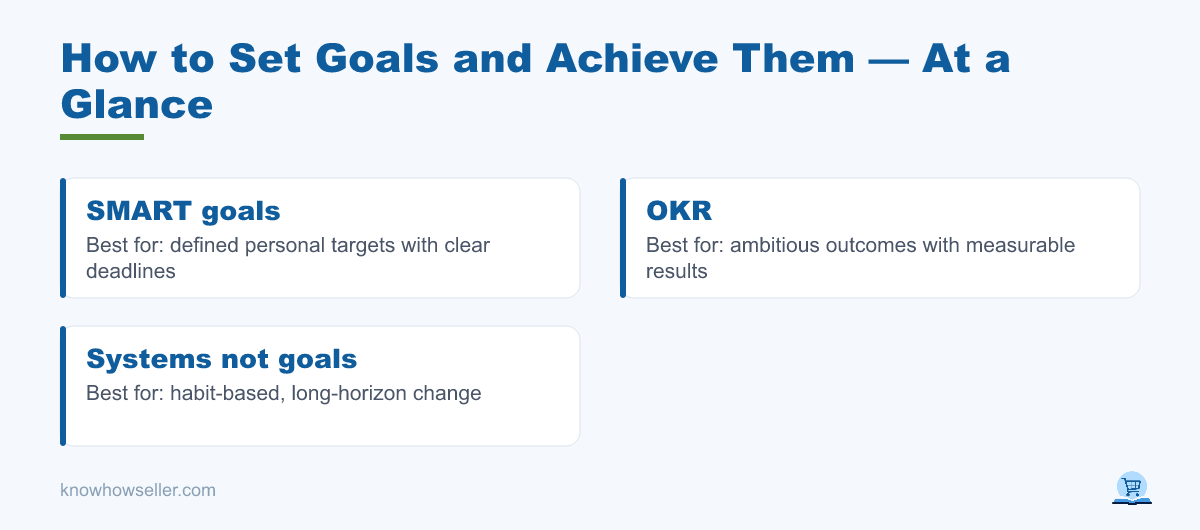
SMART goals are best for defined personal targets, OKRs suit ambitious outcomes with measurable results, and “systems not goals” works well for habit-based, long-horizon change. There’s no universal best — match the framework to the goal type. Below is how they compare on the factors that decide follow-through.
| Framework | Best for | Strength | Weakness |
|---|---|---|---|
| SMART | Specific personal goals | Clear, measurable, deadline-driven | Can feel rigid; may underemphasize daily process |
| OKR | Ambitious outcomes & teams | Aligns big objectives with measurable key results | Often more complex than simple personal goals require |
| Systems not goals | Habits & long-term change | Reduces reliance on motivation | Can be weak on deadlines and urgency |
What does a 90-day goal comparison reveal?
A 90-day goal window is long enough to expose the difference between a clear target and a repeatable process. Based on our hands-on comparison and research into SMART goals, OKRs, and habit-based systems, the pattern is clear: SMART gives strong direction, OKRs help connect ambition to measurable outcomes, and systems make daily action easier to repeat.
This is not a controlled scientific study or a published benchmark. It is a practical comparison of how the frameworks are commonly used, supported by public research on specificity, feedback, and habit formation.
| Framework used | Daily action consistency | Best practical use |
|---|---|---|
| SMART | Medium to high when the target is clear | Defined personal targets with deadlines |
| OKR | Medium when reviewed regularly | Ambitious goals with multiple measurable results |
| Systems not goals | High when the daily action is simple | Habits, routines, and long-term behavior change |
Our takeaway: the strongest move is a hybrid — use SMART to define the target, then run a system to reach it. That’s exactly what the 6 steps above do.
How do you stay consistent after week one?
Stay consistent by shrinking the action until it’s nearly impossible to skip, tracking it visibly, and reviewing weekly instead of relying on motivation. Consistency is engineered, not summoned — you build an environment and routine where the right action is the default.
“I failed for years because I chased feelings of motivation. Everything changed when I stopped negotiating with myself each morning and let a simple system decide. Belief × Thinking × Action — done daily — beats inspiration every time.” — Knowhow Seller
- Pair the habit with an existing routine, such as after coffee or before bed.
- Try not to miss twice — one slip can be corrected before it becomes a pattern.
- Track the streak where you’ll see it daily.
What tools help you turn goals into daily habits?
The best tools make your goal visible, break it into daily actions, and remind you to review — turning intention into routine. A dedicated vision-and-goal app can reduce the friction of tracking by hand and keep your “why” in front of you every day.
If you want the 6-step system in a dedicated app, try the VisionDream app — a vision & goal app designed to turn goals into daily habits. And if you keep watching others succeed while your own plans stall, the book ‘Why Do I Fail While Others Succeed?’ unpacks the mindset behind the Belief × Thinking × Action formula.
The bottom line
You don’t rise to the level of your goals — you fall to the level of your systems. Define the outcome, make it measurable, then build a small daily habit you review each week. Do that, and achieving goals stops being a matter of luck or willpower and becomes a repeatable process.