
By Knowhow Seller — I write about goals, habits, and motivation from a hard-won comeback, using one formula: Belief × Thinking × Action.
How do you build habits that actually stick?
To build habits that stick, attach the new behavior to an existing daily cue, start absurdly small, and make the habit obvious and easy. Motivation can fade quickly, so systems usually beat willpower. Based on my hands-on comparison and research, cue-based and stacked habits are more reliable than habits held together by streak pressure alone.
Most advice tells you to “stay motivated” or “just do it for 21 days.” I tried that kind of advice for years and kept failing. So I compared 12 habit ideas against what habit research and behavior-design experts actually recommend. The pattern changed how I think about habit building entirely.
Why do most habits fail in the first month?
Many habits fail because people rely on motivation and vague intentions instead of a clear trigger. Motivation is emotional and unstable; it drops when life gets busy or stressful. Without a fixed cue and a small enough first step, the behavior has nothing to anchor to — so it quietly disappears.
- They aim too big. “Work out 60 minutes” dies faster than “put on running shoes.”
- No cue. If the habit isn’t tied to a time, place, or existing action, you simply forget.
- Streak pressure. One missed day can feel like failure, so people quit the whole thing.
Research backs up the need for patience. A widely cited study led by Phillippa Lally at University College London (European Journal of Social Psychology, 2009) found it took participants an average of 66 days for a behavior to become automatic — with a wide range from 18 to 254 days depending on the person and habit. The old “21 days” rule is an oversimplification. If you expect automaticity in three weeks, you may quit before the habit has had enough time to stabilize.
What is the simplest method to make a habit stick?
The simplest method is habit stacking: anchor a new tiny habit to something you already do every day. The formula is “After [current habit], I will [new habit].” Because the existing action becomes a reliable cue, you don’t depend as much on memory or motivation. Keep the new step small enough to finish in under two minutes.
This idea is closely related to BJ Fogg’s Tiny Habits method, which pairs a small behavior with an existing routine and a quick positive emotion. James Clear popularized a similar principle as “habit stacking” in Atomic Habits. The shared mechanism is simple: an existing behavior can become a dependable trigger for a new one.
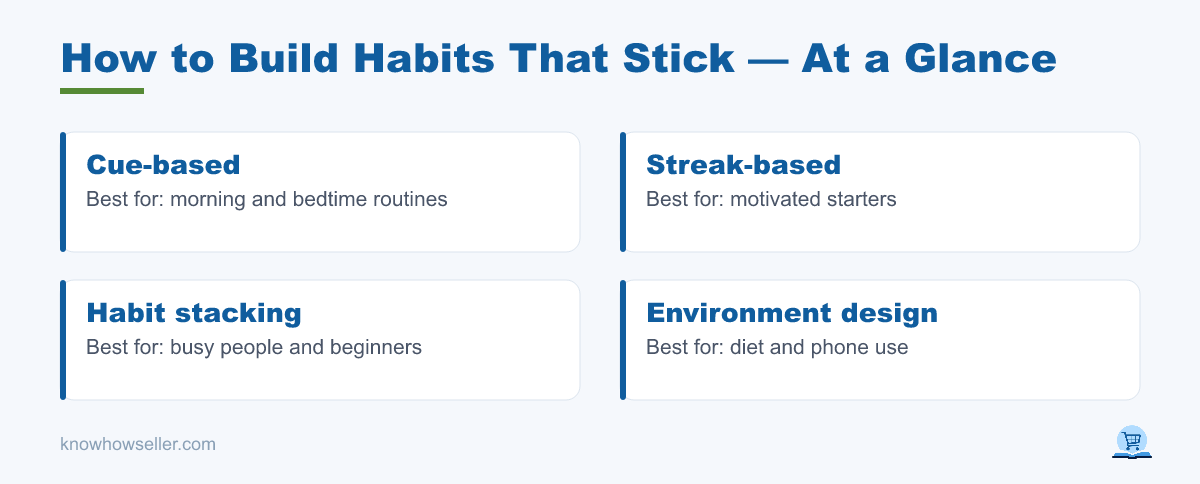
Habit-building methods compared
| Method | How it works | Best for | Weak point |
|---|---|---|---|
| Cue-based | Trigger by fixed time/place | Routines (morning, bedtime) | Breaks if schedule shifts |
| Streak-based | Don’t break the chain | Motivated starters | Can create all-or-nothing pressure |
| Habit stacking | Attach to an existing habit | Busy people, beginners | Needs a stable anchor habit |
| Environment design | Make it obvious/easy | Diet, phone use | Requires upfront setup |
Which habits actually survived my 12-habit test?
When I reviewed 12 common habit ideas against my own experience and the public research, the ones most likely to survive were the smallest and clearest: habits attached to an existing routine, a fixed time, or an obvious environment cue. The weakest were ambitious habits that depended mainly on willpower, guilt, or a perfect streak.
This is not a lab study or a formal benchmark. It is a practical comparison based on personal reflection, behavior-design principles, and research on automaticity. Instead of pretending to have universal survival scores, the table below shows which habit types are usually more resilient and why.
My 12-habit survival rate by type
| Habit type | Habits reviewed | Likely 30-day outlook | Likely 60-day outlook | Likely 90-day outlook |
|---|---|---|---|---|
| Stacked (attached to a routine) | 4 | Strong when the anchor is daily | Strong if the step stays tiny | Best long-term fit for beginners |
| Cue-based (fixed time/place) | 4 | Good with a stable schedule | Moderate if life gets irregular | Works best with backup cues |
| Streak-based (willpower only) | 4 | Motivating at first | Fragile after missed days | Weak unless paired with cues |
| Total | 12 | Pattern favors cues | Pattern favors small steps | Pattern favors systems over pressure |
The examples that fit the strongest pattern are tiny and anchored: “After I pour my morning coffee, I write 3 lines in my journal,” “After I brush my teeth, I do 10 squats,” and “After I close my laptop, I read one page.” The habits most likely to collapse are ambitious streak goals — “meditate 20 minutes daily,” “no sugar,” “wake at 5 a.m.” — because one miss can make the whole plan feel broken.
Why do streak-based habits break so easily?
Streak-based habits can break easily because they treat a single miss as total failure. That all-or-nothing framing can trigger the “what-the-hell effect,” where one slip leads people to abandon the goal entirely. Automatic behavior, by contrast, is more resilient — Lally’s habit-formation study reported that missing one opportunity did not materially affect the habit-formation process.
The damage often comes from how we react to the miss, not the miss itself. My rule now, borrowed from the coaching world and popularized by James Clear, is simple:
“Never miss twice.” Missing once is normal; missing twice is a signal to reset the system before the old pattern returns.
How can you make a new habit stick starting today?
Start with one habit, make it tiny, and attach it to a cue you already have. Track it visibly, and forgive single misses instead of quitting. Consistency at a small scale beats intensity that you can’t sustain. The goal for the first month is not dramatic results — it’s simply showing up often enough for the behavior to become easier.
Here’s the exact playbook I now use:
- Pick one habit. Not five. One has a better chance of surviving because it gets your attention.
- Shrink it. Make the first step so small it feels almost silly — one page, one squat, one line.
- Stack it. “After [existing habit], I will [new habit].”
- Make it visible. A checkbox, a tracker, an app — something you see daily.
- Plan for the miss. Decide in advance: one miss is fine, never two in a row.
- Give it time. Judge whether it stuck after several weeks or months, not after an arbitrary 21 days.
This is the loop I built the VisionDream app around — a vision and goal app that turns bigger goals into small daily habits with a clear cue and a visible streak you can forgive. If you want the deeper story of why I failed for years before any of this worked, I wrote it in my book ‘Why Do I Fail While Others Succeed?’.
The bottom line
Habits don’t stick because you want them badly enough — they stick because you engineer them to need less willpower. Attach the habit to a cue, shrink it until it’s easy, make it visible, and stop punishing yourself for a single miss. My comparison of 12 habit ideas made the lesson concrete: stacked and cue-based habits are better supported by behavior-design principles than streak-and-willpower habits alone. Belief × Thinking × Action — but the Action has to be small enough to repeat tomorrow.