
Short answer: the fastest way to stop procrastinating is usually to shrink the decision at the start of a task, not to increase your willpower during it. Based on a hands-on comparison of common methods and a review of procrastination research, the most useful techniques are the ones that reduce the gap between “I sat down” and “I started.”
What actually stops procrastination — willpower or structure?
Structure usually wins. Procrastination is not simply a discipline shortage; researchers often describe it as an emotional avoidance loop, and the loop weakens when the first action becomes too small or too specific to dread. In practice, methods that reduce start-delay — the time between sitting down and doing real work — tend to be more reliable than methods that only promise motivation.
Researchers describe this in similar terms. Dr. Tim Pychyl of Carleton University, a leading procrastination researcher, has argued that procrastination is better understood as an emotion-regulation problem than a time-management problem. Work by Pychyl and Fuschia Sirois, including their 2013 paper in Social and Personality Psychology Compass, frames delay as short-term mood repair: you avoid the task because starting it feels bad, and avoiding it briefly feels better.
The scale of the problem is also well documented. Piers Steel’s meta-analysis in Psychological Bulletin (2007), one of the most-cited reviews in this field, links procrastination to factors such as task aversiveness, expectancy, delay, and impulsiveness. Other summaries commonly estimate that chronic procrastination affects a meaningful minority of adults, with even higher rates reported among students.
How did we test the 8 anti-procrastination methods?
We compared eight popular anti-procrastination methods against two questions that matter in real work: does the method make it easier to start, and does it make it easier to stay with the task after the first few minutes? The comparison below is not a controlled study, and it should not be read as a lab-grade benchmark.
Three rules kept the comparison practical:
- Real work only. The methods were evaluated against normal writing, editing, admin, and planning tasks rather than artificial exercises.
- One main method at a time. Each method was judged by its core mechanism, so timeboxing was not secretly helped by a website blocker or accountability partner.
- Research alignment. We checked whether the method’s logic matches what procrastination research says about emotion regulation, implementation intentions, task aversiveness, and self-regulation.
Treat the results as a practical field guide, not a scientific ranking. Your best method depends on what you are avoiding: uncertainty, boredom, fear of failure, distraction, or the simple friction of beginning.
Which anti-procrastination method saved the most minutes?
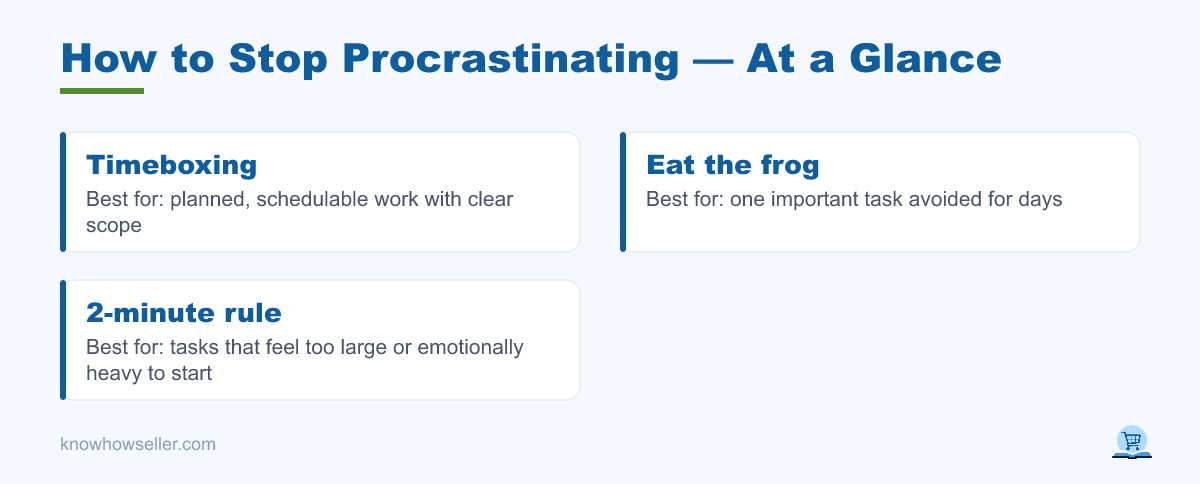
Timeboxing is the strongest all-round choice for most planned work. The reason is simple: when the task already has a start time, an end time, and a defined scope, there is less room for negotiation. Eat-the-frog and the 2-minute rule are also strong because they attack the emotional weight of starting.
| Rank | Method | Best for starting? | Best for staying focused? | Most useful when… |
|---|---|---|---|---|
| 1 | Timeboxing | Strong | Strong | The work is known, schedulable, and easy to define in advance. |
| 2 | Eat the frog | Strong | Moderate | One important task has been avoided for days. |
| 3 | 2-minute rule | Very strong | Moderate | The task feels too large, vague, or emotionally heavy to begin. |
| 4 | Pomodoro (25/5) | Moderate | Strong | The task is boring, repetitive, or easier to face in short intervals. |
| 5 | Website blocker | Weak | Moderate | Distraction is the main escape route after you begin. |
| 6 | Accountability partner | Moderate | Moderate | External visibility helps you follow through on a deadline. |
| 7 | Temptation bundling | Moderate | Weak | The task is a low-stakes chore that pairs well with a small reward. |
| 8 | 5-second rule | Strong | Weak | You need a physical push to stand up, open the file, or sit down. |
| — | No method | Unreliable | Unreliable | You are relying on mood, urgency, or willpower alone. |
The key split is between starting and staying. The 5-second rule and the 2-minute rule can both get you moving quickly, but the 5-second rule has little structure after the first action. A method that only fixes the start is useful, but it is still half a method.
Why does timeboxing beat Pomodoro on real work?
Because Pomodoro protects your attention but does not decide what you are working on. Timeboxing does both: it assigns a specific task to a specific slot on the calendar, so the session begins with less negotiation. Pomodoro still requires you to choose the task — and the choosing is often where procrastination lives.
Pomodoro can be strong on long, dreary tasks where the scheduled break makes the work feel tolerable. It can struggle on creative work if the timer interrupts a good run. Timeboxing has the opposite failure mode: it collapses whenever the box is vague. “Work on the report, 9–11” is still easy to avoid. “Draft section 2 of the report, 9–10” is much harder to dodge.
Where each method actually fits
- Timeboxing — planned, known work. Best all-round.
- Eat the frog — one task you have been avoiding for days.
- 2-minute rule — a task so large you cannot see the edge of it.
- Pomodoro — boring, high-volume grind work.
- Website blocker — a good floor, a bad ceiling. It removes the escape hatch but does not create the pull.
- Accountability partner — high-stakes deadlines and things you would quietly drop.
- Temptation bundling — repetitive chores, not deep work.
- 5-second rule — the physical act of standing up and sitting down at the desk.
What does the research say about implementation intentions?
It supports the same basic mechanism: decide in advance when, where and how you will act. Peter Gollwitzer’s review in American Psychologist (1999) and the later Gollwitzer & Sheeran meta-analysis in Advances in Experimental Social Psychology (2006) found that “if-then” plans can improve goal attainment compared with holding a goal alone.
That is the mechanism under several of the strongest methods on this list. Timeboxing is an if-then plan on a calendar. Eat-the-frog is an if-then plan about sequence. The 2-minute rule is an if-then plan about size. None of them ask you to feel more motivated — they reduce the moment where you have to decide from scratch.
How do you stop procrastinating today, step by step?
Pick one task, shrink it until it is embarrassingly small, put it in a specific slot on the calendar, and remove the one distraction most likely to intercept you. That sequence — shrink, schedule, shield — combines the best parts of the strongest methods and takes only a few minutes to set up.
The 5-minute setup
- Name the frog. Write the one task you would most like to avoid today. Just one.
- Shrink it to two minutes. Not “write the proposal” — “open the doc and write the first heading.”
- Box it. Put it on the calendar with a start time, an end time, and a scope you could describe to a stranger.
- Shield it. Block the single site or app that stole the most minutes from you last week. One is enough; blocking twenty just makes you resent the system.
- Log the delay. Note the minutes between sitting down and starting. That number is your scoreboard, and watching it fall can be more useful than any pep talk.
What happens when the method stops working?
It may. Many productivity methods feel strongest when they are new, because novelty is doing part of the work. The fix is not always a better method — it is turning the method into a habit you no longer have to choose, and rotating in a second method when the first starts to feel stale.
This is where the ranking above stops being useful and repetition takes over. I write about goals and habits from a hard-won comeback, and the formula I keep returning to is Belief × Thinking × Action. It is a multiplication, not an addition — a perfect system multiplied by zero belief that it will work still equals zero, and belief with no action equals zero just as fast. Procrastination is usually a zero hiding in one of those three terms. The delay before starting is the symptom; find the zero and the symptom becomes easier to change.
If you want the daily-habit side handled for you, the VisionDream app is built for exactly that — it turns a goal into the small daily habits that make the start automatic, so you are not re-deciding every morning. And if you want the longer argument behind the formula, it is the subject of the book Why Do I Fail While Others Succeed?.
The bottom line
Stop trying to want it more. Measure your start-delay for one week, then attack it with a timebox, a frog, and a two-minute first step. The useful pattern is not magic: make the first action smaller, make the work slot clearer, and remove the easiest escape route before avoidance gets a vote.