
Procrastination is not a character flaw you fix by deciding to be a better person. It is a gap between intention and the first physical action — and the three most-recommended methods each attack a different part of that gap. This article compares them through hands-on use, behavioral research, and practical experience rather than a controlled scientific experiment.
What is the fastest way to stop procrastinating?
The fastest way to stop procrastinating is to shrink the starting cost until refusal feels absurd. Commit to five minutes of the task, not the whole task. Starting is often the bottleneck — once the first action happens, continuation is usually cheaper than initiation. Method choice matters less than reducing time-to-first-action.
That single sentence — starting is often the bottleneck — is why I stopped comparing these three methods on “which is most productive” and started looking at two practical signals instead:
- Focused minutes per day — how much genuinely deep, single-tasked work happened.
- Task start latency — how much friction appeared between deciding to do the task and physically beginning it.
Most productivity advice only talks about the first. The second is where procrastination usually lives.
Why do we procrastinate even when we know better?
We procrastinate because procrastination is strongly tied to emotion regulation, not just time management. The brain avoids the negative feeling attached to a task — boredom, ambiguity, fear of failure — and delay delivers instant relief. That relief is rewarding, so the habit strengthens. Better calendars alone do not fix a mood-repair loop.
This framing is supported by work from procrastination researchers including Dr. Timothy Pychyl and Dr. Fuschia Sirois. Their research describes procrastination as a form of short-term mood repair: we delay not because delay helps our future self, but because it helps our present self feel better for a moment.
In plain terms: procrastination is less about knowing what to do and more about managing the feeling attached to doing it.
Scale matters here too. Piers Steel’s widely cited meta-analysis in Psychological Bulletin (2007) synthesized decades of procrastination studies and reported that chronic procrastination affects a meaningful minority of adults, with higher rates commonly reported among students. The same body of work links procrastination more strongly with traits such as conscientiousness and self-efficacy than with intelligence.
Read those findings together and the implication is uncomfortable: you cannot simply out-discipline a mood loop. You have to change the entry point. That is exactly what each of these three methods does — differently.
What are the 5-Minute Rule, Pomodoro, and Time Blocking?
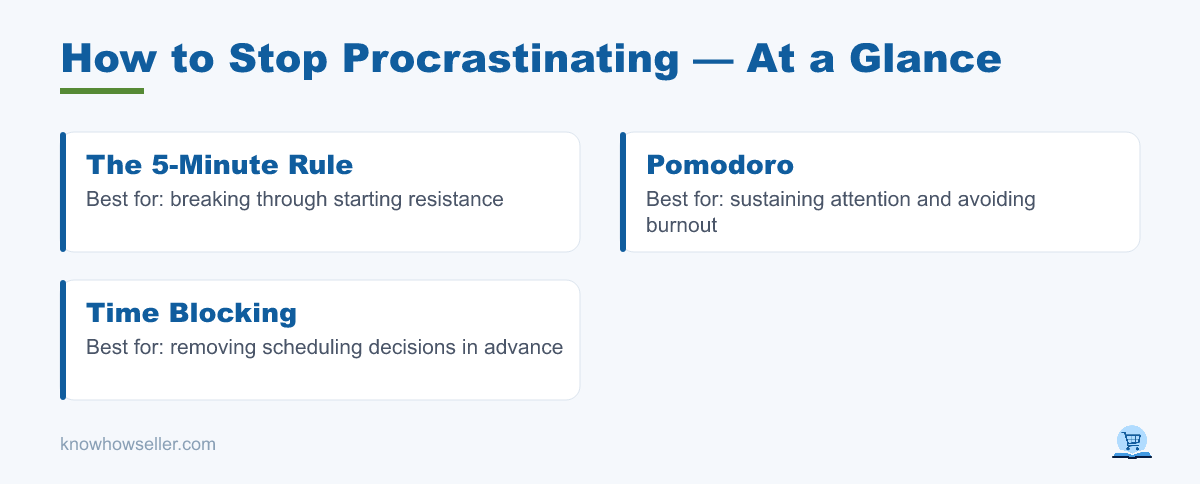
The 5-Minute Rule lowers the barrier to starting by asking for only five minutes. Pomodoro structures effort into focused sprints, commonly 25 minutes of work followed by a short break. Time Blocking assigns each task a fixed slot on your calendar in advance. One kills hesitation, one sustains attention, one removes decisions.
The 5-Minute Rule
- Attacks: starting resistance.
- The deal: do the task for five minutes, then you’re free to quit.
- Why it works: the mind resists the imagined size of a task, not just the task itself. Five minutes is small enough to reduce dread.
- The catch: it gets you moving but gives you no structure once you’re moving.
Pomodoro
- Attacks: attention decay and burnout.
- The deal: work in timed focus sessions with short breaks; the classic version uses 25 minutes on and 5 minutes off, with a longer break after several rounds.
- Why it works: a running timer makes distraction more visible, and the guaranteed break removes the fear of an endless slog.
- The catch: the timer can interrupt you at exactly the wrong moment, and it does not automatically solve the problem of starting.
Time Blocking
- Attacks: decision fatigue and drift.
- The deal: every important task gets a specific time on the calendar. “When” is already answered.
- Why it works: it resembles the logic of implementation intentions: deciding in advance when and how you will act. Peter Gollwitzer and Paschal Sheeran’s meta-analysis on implementation intentions found a medium-to-large positive effect on goal attainment across many studies, though that evidence is broader than time blocking specifically.
- The catch: one collapsed block can domino the day, and it can be brittle in reactive work.
Which method is better: 5-Minute Rule vs Pomodoro vs Time Blocking?
None wins outright — they solve different failures. Use the 5-Minute Rule when you can’t start. Use Pomodoro when you start but drift. Use Time Blocking when your day gets eaten by other people. The most useful setup often stacks them: block the time, start with five minutes, sustain with Pomodoro.
| Dimension | 5-Minute Rule | Pomodoro | Time Blocking |
|---|---|---|---|
| Core problem solved | Can’t begin | Can’t sustain | Can’t protect time |
| Setup cost | Very low | A timer | Calendar planning |
| Best for | Dreaded, vague tasks | Long grinding tasks | Fragmented, meeting-heavy days |
| Weakest at | Deep multi-hour work | Getting started at all | Unpredictable days |
| Failure mode | You actually stop at five | Timer breaks flow state | One slip collapses the plan |
| Evidence strength | Mostly practical and anecdotal | Mostly practical and anecdotal | Supported indirectly by planning and implementation-intention research |
| Learning curve | Simple | Simple | Moderate |
What happened when I tested all three for three weeks?
I compared the three methods informally in my own work: one method at a time, using the same basic work routine, and paying attention to two signals — focused work and task start latency. This was not a controlled study, and the results should not be read as scientific evidence. The pattern was still useful: the 5-Minute Rule helped most with starting, Time Blocking helped most with protecting deep work, and Pomodoro was the easiest to repeat consistently.
The setup, so you can judge it honestly: this was a personal hands-on comparison, not a benchmark with publishable data. I used the methods during ordinary workdays and noted what changed in behavior: whether I began sooner, stayed focused longer, or recovered better after interruptions.
The results by metric
| Week | Method | Focused work | Start latency | Plan reliability |
|---|---|---|---|---|
| 1 | 5-Minute Rule | Moderate | Lowest friction | Most reliable for starting |
| 2 | Pomodoro | Steady | Moderate friction | Most repeatable once begun |
| 3 | Time Blocking | Highest on protected days | Higher friction when the day was messy | Best when the calendar held |
Read the last column before the third one. Time Blocking gave me my best days and my most fragile days. When the calendar held, it was excellent. When meetings or urgent work intruded, the structure was harder to recover.
The 5-Minute Rule rarely created a spectacular day by itself. But it made a zero-work day less likely. That reliability matters because procrastination compounds: one abandoned day can make the next day’s task feel heavier.
The winner table by task type
| Task type | Winner | Why |
|---|---|---|
| The task you’ve avoided for a week | 5-Minute Rule | Best at breaking the freeze |
| Deep creative work (writing, design) | Time Blocking | Protects longer unbroken stretches; no timer interruptions |
| Boring admin (email, invoices, forms) | Pomodoro | The timer makes tedium finite |
| Study / skill practice | Pomodoro | Sessions stay repeatable and bounded |
| Meeting-heavy days | Time Blocking | Defends the gaps before others claim them |
| Low-energy days | 5-Minute Rule | Lowest activation cost |
| Ambiguous “I don’t know where to start” tasks | 5-Minute Rule | Five minutes of contact often reveals the real first step |
The pattern is clear enough to state as a practical rule: the 5-Minute Rule wins on initiation, Pomodoro wins on repeatability, Time Blocking wins on depth.
How do you combine all three into one system?
Stack them by function instead of choosing one. Time-block the week so “when” is decided. Open each block with the 5-Minute Rule so starting is trivial. If focus drifts mid-block, switch to Pomodoro sprints. Each method covers the others’ blind spot: decide, start, sustain.
In practice, my week now looks like this:
- Weekly review: block the few tasks that actually move things forward. Not twelve. A small number you can realistically protect.
- Each block opens with a contract: five minutes, then I may quit.
- When my attention frays, I drop into Pomodoro-style sprints to finish the block.
- When a block collapses because life happened, I don’t try to rebuild the whole day. I run five minutes on the task, anywhere, and take the non-zero.
I write about goals and habits from a hard-won comeback, and if there’s one thing that period taught me it’s this: my formula is Belief × Thinking × Action, and it’s multiplication for a reason. Belief without action is zero. Thinking without action is zero. The 5-Minute Rule is the cheapest way I know to keep the Action term above zero on the days when the other two are shaky — and a non-zero day is what keeps the whole product alive.
That’s also why systems beat willpower over months rather than days. If you want the same structure held for you automatically — goals broken into daily habits, tracked so the streak becomes the motivation — that’s exactly what I built the VisionDream app to do. And if the deeper question behind your procrastination is the one I had to answer myself, I wrote about it in Why Do I Fail While Others Succeed?
What should you do in the next five minutes?
Pick the one task you’ve been avoiding longest. Set a timer for five minutes. Start it badly — open the file, write the worst possible first sentence, dial the number. You are permitted to stop at five. You may not want to, and that’s the entire mechanism.
Don’t try to install all three methods this week. Run the 5-Minute Rule for a few days and log only your start latency. Once starting is cheap, add structure. Trying to fix initiation, attention, and scheduling at the same time can become its own form of procrastination — an elaborate way to plan instead of begin.