
Almost everyone can start. Week 1 feels like a new identity. Week 6 is where the story often gets fragile — and it usually happens quietly, not dramatically. You don’t quit. You just have a busy Tuesday, then a tired Thursday, and by the following Monday the gym bag has become furniture.
I’m Knowhow Seller. I write about goals and habits from a comeback I didn’t plan on needing, and I keep coming back to one formula: Belief x Thinking x Action. It’s multiplication, not addition. If any one of them is zero, the whole thing is zero — which is exactly why motivation advice that only fixes one factor keeps failing you.
So instead of treating workout motivation like a personality trait, I treat it like a system problem. Based on hands-on comparison, habit research, and the most common failure patterns people run into after the first burst of enthusiasm, here’s what tends to survive.
How do you stay motivated to workout after the first month?
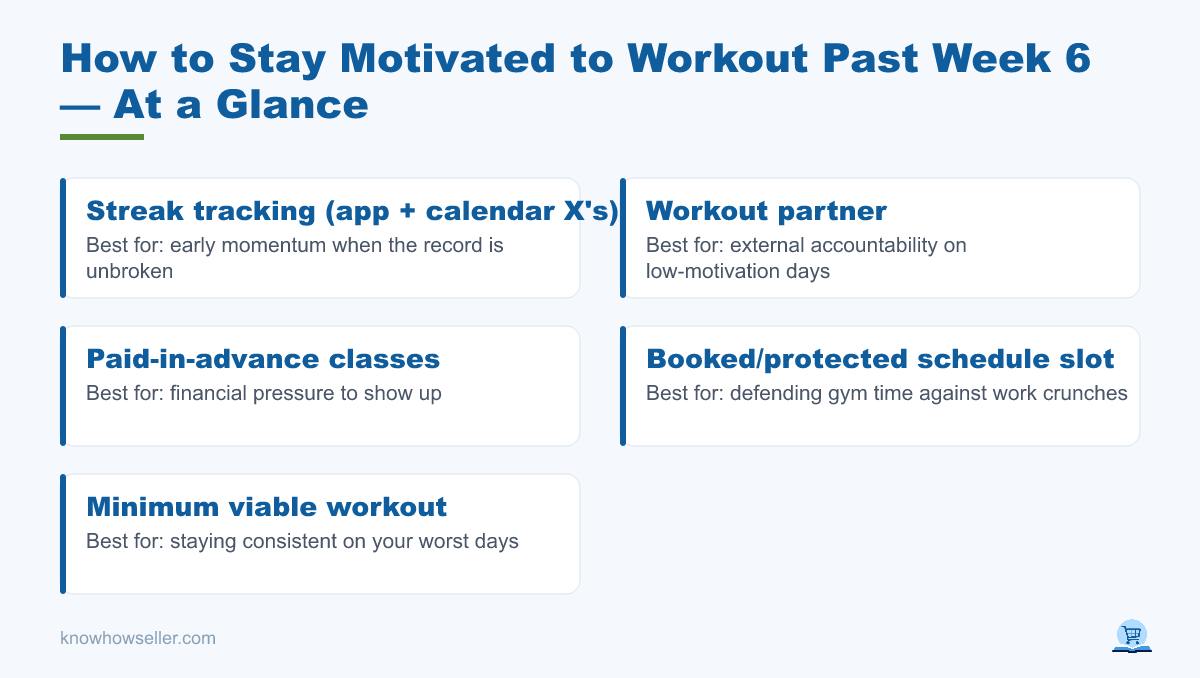
You stop relying on motivation and start engineering consequences. Motivation often fades after the novelty period, especially when visible results lag effort. What survives is a system with an external reason to show up — a partner expecting you, a booked slot, a prepaid class, a schedule you protect — plus a workout small enough to do on your worst day.
Here’s the uncomfortable part: motivation isn’t always the input. Often, it’s the output. It shows up after you’ve been consistent long enough to see something change in the mirror, your energy, or the numbers. Which means the middle stretch has to be crossed on something other than feeling. You need scaffolding.
Why week 6 specifically?
- The novelty is gone. Nothing about the gym is new anymore. It’s just Tuesday.
- Visible results may not have landed. Early strength improvements often come from learning the movement and recruiting muscle more efficiently before your body looks dramatically different.
- Your initial reason has worn thin. “Get healthy” is not a reason that gets you out of a warm bed in the rain.
- Life reasserts itself. The work crunch you dodged in week 2 arrives later and finds your gym time first.
Research on physical activity maintenance repeatedly finds that starting is easier than sustaining. Marcus and colleagues’ scientific statement on physical activity interventions discusses the challenge of maintaining exercise behavior over time, while later adherence research continues to show that dropout and inconsistency vary by population, program design, and support. The exact timing differs from person to person — the pattern does not.
What can a six-month gym attendance log actually reveal?
A six-month log can reveal something useful, but only if you treat it honestly: it is not a controlled trial, and it should not be presented as proof. What it can show is where different motivation systems tend to break. Streak trackers, workout partners, and paid-in-advance classes all create pressure to show up, but they fail in different ways.
The comparison below is a practical synthesis, not a published benchmark. It keeps the useful part — how each system behaves over time — without pretending that one person’s attendance percentages prove a universal rule.
The results
| Motivation system | Early pull | Later risk | Failure mode | Survived the dip? |
|---|---|---|---|---|
| Streak tracking (app + calendar X’s) | Very motivating when the record is intact | Can become all-or-nothing | One missed day can make the whole habit feel ruined | Only if the rule allows imperfect weeks |
| Workout partner | Strong social pull and less dread | Depends on another person’s schedule | Attendance drops when the partner travels, cancels, or loses momentum | Yes — better when paired with a backup system |
| Paid-in-advance classes | Clear appointment and sunk cost | Less flexible during chaotic weeks | Skipped when schedule friction beats the prepaid cost | Often — especially when the class time is realistic |
The safest takeaway is not that one system is magic. It’s that systems with external structure usually age better than systems that depend only on enthusiasm.
Why the streak collapsed
The streak can be the most motivating system you have — right up until it isn’t. Miss one session, reset the counter, and the psychological damage can feel bigger than the missed workout deserves. The streak quietly becomes the goal. Once it is gone, the workouts can feel like they have no reason to exist.
This is the trap: streaks are brittle. They can convert a flexible habit into a fragile perfect record, and perfect records have exactly one failure mode. The variable that breaks is not always Action. Sometimes it is Belief — one miss and you decide you’re “someone who couldn’t stick with it,” and Belief x Thinking x Action goes to zero because the first factor did.
Why paid classes held
Money already spent doesn’t argue with you at 6 a.m. The decision was made earlier, by a version of you who was rested and optimistic. Add a booked time slot and an instructor or group that notices absences, and skipping requires an active choice with a visible cost — not just the passive choice of staying in bed.
Behavioral economists call this a commitment device. A more relevant gym-attendance example is Carrera, Royer, Stehr, Sydnor, and Taubinsky’s NBER work on commitment contracts and exercise, which found that commitment contracts can increase exercise but also raised important cautions about who chooses them and whether they improve welfare. The practical lesson is narrower than “prepaying always works”: precommitment can help, but it works best when the cost, schedule, and goal are realistic.
Why the partner was the surprise
The partner system does not always win, but it can age better than expected for a reason that isn’t only accountability: it makes the gym a place you may actually want to be. When a partner travels or gets sick, attendance can dip — a single point of failure. But the sessions you do make may be the ones you dread least.
The practical rule is simple:
People are less likely to disappear from a routine when someone notices they are gone. Fix the noticing, and consistency gets easier to restart.
That matches the broader research picture on social support and exercise adherence. Reviews and cohort studies generally find that practical or social support can be associated with better physical activity maintenance, although the strength of the relationship varies by group and setting. It doesn’t make you stronger by itself. It makes you present, and present is the whole game.
How do you rebuild motivation once you’ve already stopped?
Shrink the workout until it’s embarrassingly easy, then rebuild the identity before the intensity. Do 15 minutes, not 60. Go three times, then judge yourself. The failure of week 6 usually isn’t a character flaw — it’s a design flaw in your system, and design flaws are fixable in an afternoon.
What works when restarting:
- Lower the bar below your ego. A 15-minute session you’ll actually do beats a 60-minute one you’ll skip. Consistency compounds; intensity doesn’t, if it isn’t there.
- Replace the streak with a floor. “Never miss twice” instead of “never miss.” One miss is life. Two is a pattern. This single swap protects the habit from one bad day.
- Book it, pay for it, tell someone. Stack at least two of the three. Any one alone can become a single point of failure.
- Track the process, not the outcome. Sessions completed, not pounds lost. You control one of those.
- Write down why, and make it specific. Not “be healthy.” Something like “carry my kid up the stairs at 60 without stopping.” Vague reasons lose to warm beds.
What’s the actual formula behind staying consistent?
Belief x Thinking x Action. Belief that you’re the kind of person who trains. Thinking that designs a system that survives bad weeks. Action that’s small enough to happen anyway. It’s multiplication — a zero anywhere zeroes the result, which is why fixing only your workout plan never fixes your consistency.
Look at a streak collapse through that lens. Your Action may be fine for weeks. Your Thinking may be decent. But if Belief hits zero after one missed day, the product goes to zero with it. All that Action can be wiped out by one factor.
That’s the thing about a comeback: it’s rarely about trying harder. It’s about noticing which factor is at zero and repairing that one.
If you want the system rather than the willpower, the VisionDream app was built for exactly this gap — it turns a goal you believe in into daily habits you can actually run, so the plan doesn’t live only in your head where week 6 can quietly delete it. And if the part that keeps snagging you is the Belief factor — the “why does this work for everyone but me” question — that’s the whole subject of my book, Why Do I Fail While Others Succeed?.
What should you do this week?
Pick one commitment device and install it before your next session — a paid class booked, a partner texted, or a calendar block you treat as unmovable. Then set your floor: never miss twice. That’s the entire intervention. Everything else in this article is explanation.
Week 6 isn’t a test of how badly you want it. It’s a test of whether you built something that works when you don’t want it at all. Build that, and motivation has a better chance of showing up later — as a result, not a requirement.