
An AI article generator does not know what it has already published unless you make it check. Left alone, it will happily write the fourth post about the same query, and every one of them will compete against the other three. The fix is not better prompts. It is a gate that runs before generation and refuses topics that land inside an existing cluster.
This guide covers how that gate is built, what it catches, and the one signal most people miss: what it means when the gate rejects everything.
What is AI content topic clustering, and how does it stop cannibalization?
AI content topic clustering groups every published and planned post into semantic clusters, then blocks any new candidate that falls inside an existing cluster. Cannibalization stops because the generator can never produce a second article aimed at the same intent — the rejection happens before generation, not after publication and cleanup.
The distinction matters because post-publication deduplication is expensive. You have already paid for generation, editing, and publishing, and you now owe a merge, a redirect, and a re-indexing wait. A pre-generation check costs one embedding comparison.
How do you know your generator is cannibalizing its own posts?
Three signals give it away: two of your URLs swap positions for the same query in Search Console, impressions climb while clicks stay flat, and fresh posts settle into “Duplicate without user-selected canonical” or “Crawled — currently not indexed.” Any one of these means the pipeline is producing overlap rather than coverage.
Google’s own documentation on canonicalization is blunt about the mechanism: when Google sees near-identical pages, it picks one canonical and the others lose their independent standing. There is no penalty — there is just a page you paid for that will never rank on its own.
Scale sharpens the problem. In its March 2024 core update announcement, Google said it expected the changes to reduce low-quality, unoriginal content in search results by about 40%, and it explicitly named content produced at scale primarily for rankings. Separately, Ahrefs’ widely cited study of roughly a billion pages reported that 96.55% of the pages in its index received no organic search traffic from Google. Both figures come from those published sources, not from measurements of our own. An automated pipeline without a clustering gate manufactures candidates for that no-traffic majority on a schedule.
Knowhow Seller runs a self-reinforcing content engine that publishes to WordPress daily, behind an index gate: when Google’s indexed share of mature posts falls below a threshold set for the site, the engine throttles its own output. Running it surfaced a bookkeeping problem worth planning for — URLs that were deleted can linger in the submitted set, and a pipeline’s internal record of what exists drifts from reality unless something reconciles the two.
What should a pre-generation duplicate-cluster check include?
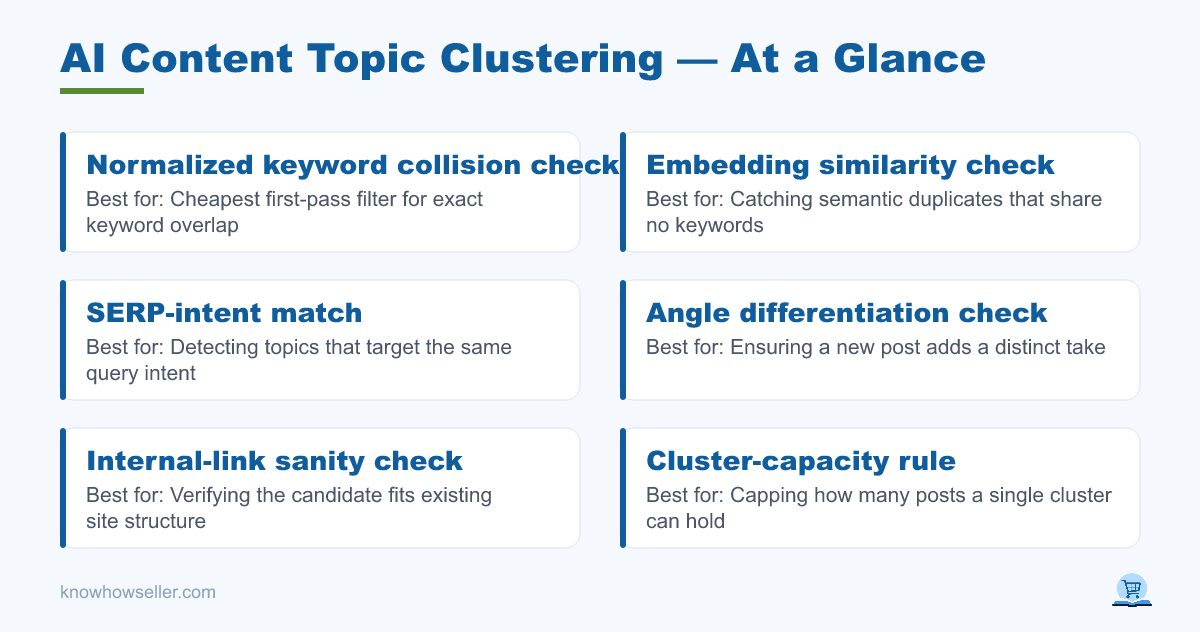
A working gate runs six checks against every candidate topic before a single token is generated: normalized keyword overlap, embedding similarity to published posts, SERP-intent match, angle differentiation, an internal-link sanity check, and a cluster-capacity rule. A candidate must clear all six or it is rejected and logged.
The checklist, in the order it should run (cheapest filters first):
- Normalized keyword collision. Lowercase, strip stopwords, stem, then compare against the primary and secondary keywords of every published post. An exact or near-exact primary keyword match is an automatic reject.
- Embedding similarity. Embed the candidate title plus its intended outline, compare by cosine similarity against stored embeddings of every published post. Anything above your threshold is flagged. Pick the threshold empirically on your own archive — a value tuned on someone else’s corpus will misfire on yours.
- Search intent match. Same keyword but genuinely different intent (how-to vs. review vs. comparison) is sometimes legitimate. Same keyword and same intent never is.
- Angle differentiation. The candidate must state, in one sentence, what it answers that no existing post answers. If that sentence can be written about a post you already have, it is not a new article — it is an update.
- Internal-link test. If the candidate would naturally be linked from the same anchor text as an existing post, they are competing for the same slot.
- Cluster capacity. Cap the number of spokes per cluster. When a cluster is full, new candidates route to “update existing” instead of “generate new.”
Which duplicate-detection method should you use?
Layer them. Lexical matching is nearly free and catches the obvious repeats; embeddings catch reworded duplicates; SERP overlap catches topics that are different on paper but identical to Google. No single method covers all three failure modes, and running them in cost order keeps the expensive checks rare. The table below compares the methods on publicly verifiable properties — what each technique can and cannot see, and its relative cost — not on scores from a private benchmark.
| Method | Catches | Misses | Relative cost | Where it belongs |
|---|---|---|---|---|
| Exact / normalized keyword match | Literal repeats of a primary keyword | Synonyms, paraphrases, question forms | Negligible | First filter, always on |
| Lexical overlap (TF-IDF / BM25) | Heavy vocabulary reuse across outlines | Same intent expressed in different words | Very low | Second filter |
| Embedding cosine similarity | Reworded and reframed duplicates | Topics that only converge on the live SERP | Low (one call per candidate) | Core gate |
| SERP overlap of top results | Distinct keywords that Google treats as one topic | Brand-new or zero-volume queries | Moderate (API dependent) | Cluster design, run periodically |
| LLM judge vs. existing titles + outlines | Angle duplication a vector can’t see | Anything outside the context you hand it | Highest | Final check on survivors only |
Feed the LLM judge only the candidates that survived the cheaper layers, and give it the actual outlines of the nearest neighbors — not just titles. A judge shown three titles will approve almost anything.
What does it mean when 7 of 7 candidate topics get rejected?
It means the seed keyword list is exhausted, not that the gate is broken. A run in which every candidate is rejected as cannibalizing an existing post is the most useful output the gate produces: it is the stop signal that a niche has been covered at the current depth.
Most operators read a run like that as a bug and loosen the threshold. That is exactly backwards. A gate that rejects everything is telling you something the analytics will not tell you for another three months.
When a run comes back with every candidate rejected, the productive responses are:
- Go deeper, not wider. Mine the existing posts for sub-questions that were mentioned but not answered. These are genuinely new spokes, not re-runs.
- Switch the run to updates. Route the rejected candidates into a refresh queue for the posts that blocked them. The overlap that caused the rejection is a map of what to expand.
- Add adjacent intents. The same keyword set with a different intent (comparison, pricing, migration, troubleshooting) often opens a legitimate second tier.
- Reseed the list. Pull new seeds from Search Console queries you already receive impressions for but have no dedicated page for.
- Log the rejection with its reason. A rejection log is a coverage map. Without it you will regenerate the same rejected topic next month.
Publishing volume is not the goal. A run that publishes zero articles and correctly identifies that the niche is saturated has done more for the site than a run that ships seven near-duplicates.
How do you clean up posts that already cannibalize each other?
Pick one winner per cluster, then merge the rest into it: fold the unique sections into the winner, 301-redirect the losers, and repoint internal links to the surviving URL. Where merging isn’t appropriate, differentiate the intent and set canonicals deliberately rather than leaving the choice to Google.
Order of operations that avoids losing equity:
- Export Search Console query data and find queries where more than one of your URLs appears.
- Choose the winner by existing rankings and backlinks, not by publication date.
- Move genuinely unique content from the losers into the winner before redirecting — a redirect that discards content discards the reason someone linked to it.
- Update internal links to the winner directly. Redirect chains still resolve, but they add latency and one more thing to break later.
- Re-check indexing status weeks later, not days later. Consolidation is not instant.
How do you keep the clustering gate itself from failing silently?
Run the verification step across two independent vendors and alert whenever the fallback fires, even on success. A single-vendor gate fails closed and looks identical to “no good topics this week” — the scheduler reports success, the log looks clean, and publishing quietly goes to zero.
This is the failure mode Knowhow Seller’s engine hit more than once. A verifier LLM stopped responding — once because credentials expired, once because a usage quota ran out — and publishing fell to zero for an extended stretch while every scheduled task kept reporting success. Nothing in the logs said “failed.” The gate simply approved nothing.
The fix was structural, not a bug patch:
- Split the verification gate across two different vendors. A quota exhaustion or auth expiry at one provider no longer takes the gate down.
- Alert on fallback success, not just on failure. “The backup worked” is the warning; if you only alert on hard errors, you learn nothing until the backup also dies.
- Monitor published count as a heartbeat. Zero publishes for N consecutive days is an alert condition regardless of exit codes.
- Keep the watchdog outside the system it watches. A monitor running inside the pipeline dies with the pipeline.
Worth noting: none of this was diagnosed by reading source code. Knowhow Seller is not a developer and cannot read code — every failure was traced by pasting the error back into the AI and writing down the blockage as it happened. That habit is why the pattern was recoverable at all, and over time it built a library of reusable notes from only four triggers: something broke, a problem recurred a third time, a decision needed a record, or a snippet became worth copying.
What does the finished pipeline look like?
Seed keywords enter, the six-point checklist filters them, survivors go to generation, and rejections go to a logged refresh queue. A two-vendor verification gate sits before publishing, an index gate throttles output when the indexed share of mature posts falls below the threshold you calibrated for your own site, and an external watchdog alerts on zero-publish days.
The counterintuitive part is that the gate’s most valuable output is a rejection. A generator that publishes less but never competes with itself beats one that fills a sitemap with pages that will never rank.