

Adding an AI second-opinion reviewer to your workflow feels free. It isn’t. The cost shows up as a churn loop: the reviewer critiques work that isn’t finished, you rewrite it, the reviewer critiques the rewrite, and a day disappears without the feature getting closer to done. The fix is not a better reviewer — it’s a better cadence.
How often should AI review your work?
Review once per completed unit of work — typically at session end — not after every edit. An AI reviewer cannot tell an unfinished draft from a finished one, so per-edit review generates critiques of work you were already going to change. Session-end review gives the model a coherent, complete artifact to judge.
That’s the short answer. The longer answer is that “unit of work” is doing the heavy lifting in that sentence, and getting it wrong in either direction is expensive. Too small a unit and you’re back in the churn loop. Too large and the reviewer is handed a diff so big it will skim rather than read.
What is the AI review churn loop?
The churn loop is a feedback cycle where an AI reviewer critiques incomplete work and the author reflexively rewrites it. Because the critique is always technically valid — unfinished code genuinely does have gaps — the author never develops resistance to it. Work oscillates instead of converging, and hours vanish with no net progress.
We ran into this in our own workflow. Running an AI second-opinion review on every single code edit produced exactly this pattern: the reviewer flagged missing error handling, absent tests, and unhandled edge cases in code that was mid-write, and we rewrote in response every time. Moving the review to once per session end ended it — not by changing the reviewer, the prompt, or the model, but by changing when it ran. That’s an account of how we work, not a measured experiment.
Three things make this loop especially sticky:
- The critique is never wrong. Half-finished code always has real defects, so there is no obvious signal to ignore the feedback.
- The reviewer has no memory of intent. It doesn’t know the error handling was scheduled for the next commit.
- Responding feels productive. You are typing, files are changing, the diff is growing. It reads as work.
Worth stating plainly for context: the author of this article is not a developer and cannot read code. Every failure in our stack was diagnosed by pasting the error back to an AI. That makes AI review genuinely load-bearing here — which is precisely why the cadence had to be fixed rather than the tool abandoned.
Which review cadence should you pick?
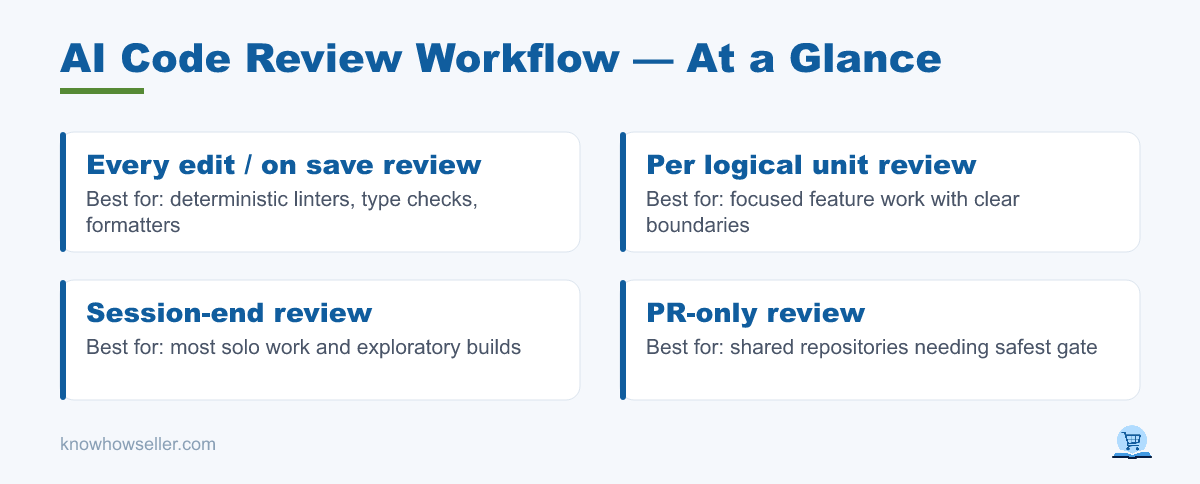
Pick the smallest cadence at which the reviewed artifact is coherent on its own. For most solo and small-team work, that is session end or logical-unit completion. Per-edit review suits only narrow, mechanical cases like linting. PR-only review is safest for shared repositories but delays feedback the longest. The table below is a reasoning aid built from how each cadence works, not a scored test result.
| Cadence | What the reviewer sees | Main failure mode | Best for |
|---|---|---|---|
| Every edit / on save | Fragments, mid-write state | Churn loop; critiques of work you were already changing | Deterministic linters, type checks, formatters |
| Per logical unit (a feature, a fix) | A self-contained change | Requires discipline to define “unit”; easy to drift smaller | Focused feature work with clear boundaries |
| Session end | Everything you changed this sitting | Large sessions produce diffs too big to review well | Most solo work, exploratory builds, non-developer operators |
| Pull request only | A merge-ready branch | Slowest feedback; rework is more expensive by then | Shared repos with real review gates |
| Event-triggered (see below) | A specific incident or decision | Nothing runs if you never notice the trigger | Layering on top of any cadence above |
What does the research say about reviewing too often?
Published research doesn’t measure AI review cadence directly, but three findings converge: AI assistance can slow experienced developers, AI adoption correlates with reduced delivery stability, and human review quality collapses past a certain volume. All three point the same way — more review events is not more quality.
- METR’s 2025 randomized controlled trial reported that experienced open-source developers took roughly 19% longer to complete tasks when using AI tools, while estimating afterwards that the tools had made them meaningfully faster. The perception gap is the dangerous part: a churn loop feels productive from the inside.
- DORA’s 2024 State of DevOps Report (Google Cloud) reported that an increase in AI adoption was associated with a small decrease in delivery throughput and a notably larger decrease in delivery stability. AI in the loop shifted where the friction landed rather than removing it.
- The Cisco/SmartBear code review study is the source of the widely cited guidance that defect-detection effectiveness drops sharply once reviewers exceed roughly 200–400 lines of code in a sitting, and after about an hour of continuous review. This is the ceiling that argues against letting “session end” become “end of a nine-hour session.”
- Stack Overflow’s 2025 Developer Survey found the top AI frustration among developers was solutions that are “almost right, but not quite,” and that only about a third of respondents trust the accuracy of AI output. Almost-right feedback is exactly what fuels reflexive rewriting.
None of these studies tested review frequency as a variable, and none of them are ours. Treat them as converging evidence for the direction, not proof of the specific cadence.
How do you set up a session-end AI code review workflow?
Define what counts as a session, block review during active editing, run one review against the full session diff, and apply only high-confidence findings. The discipline that matters most is the second step — an AI code review workflow fails from being available at the wrong moment, not from being poorly configured.
The step-by-step version is in the tutorial steps below. Two rules deserve emphasis here.
Filter by severity, not by volume. Apply correctness and security findings. For style and preference findings, record the reason you’re declining and move on. Reflexively re-editing on low-severity feedback is the churn loop wearing a different hat.
Keep the reviewer outside the thing it reviews. We learned this the hard way with monitoring, not review: a watchdog process running inside the system it watches dies with that system and reports nothing. The same logic applies to review — a reviewer sharing state with the work it judges will inherit that work’s assumptions.
What should trigger a review outside the normal cadence?
Four events justify an off-schedule review: something broke, a problem recurred for the third time, a decision needs a written record, or a fragment became worth reusing. These are the same four triggers that produced most of our reusable knowledge base — they mark the moments where capture actually pays for itself.
When we look back at why each durable note in that library got written, it almost always traces to one of those four moments; little else produced anything we reused. That’s a useful filter for review too, because both activities answer the same question: is this moment worth spending attention on?
- Something broke. Review the failure and the fix together, while the error output is still in front of you.
- A problem recurred a third time. First occurrence is noise, second is coincidence, third is a pattern worth reviewing structurally.
- A decision needed a record. Have the reviewer stress-test the reasoning before it hardens into an assumption nobody revisits.
- A snippet became worth copying. Anything about to be reused deserves one careful pass, because its defects propagate.
Everything else waits for session end.
When is per-edit AI review still the right call?
Per-edit review works when the check is deterministic and the output is binary. Linters, type checkers, formatters, and secret scanners have no opinion about whether your work is finished — they either match a rule or they don’t. Run those continuously. Reserve judgment-based review, which requires context about completeness, for the session-end cadence.
The distinction is whether the tool can be wrong in an interesting way. A type checker that flags an error is right or it isn’t. An AI reviewer that says “consider extracting this into a helper” is offering a plausible opinion about code it doesn’t fully understand the purpose of — and plausible opinions, delivered often enough, will reorganize your entire day.
What does this cost you if you get it wrong?
The worst outcome isn’t wasted hours — it’s silent drift. A review loop that runs constantly produces so much output that you stop reading it, at which point the review is theater. We’ve watched a related failure mode play out: an automated pipeline in our own setup reported success for weeks while its verification gate was dead. Every scheduled task said OK. Nothing was actually being checked.
We fixed that one by having an independent second check confirm the result, and by alerting even when the fallback path succeeded. The review analogue is simpler: if your AI reviewer has agreed with you for a long stretch, that isn’t a quality signal. Check that it still runs, and check that you still read it.